Mountmellick embroidered handkerchief
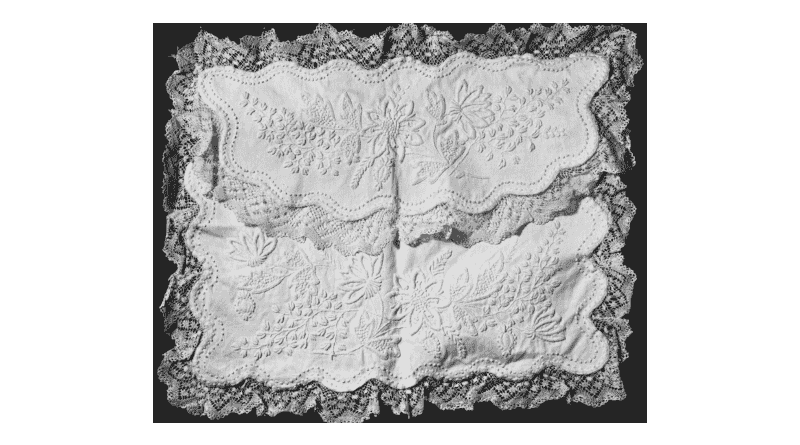
The Mountmellick embroidered handkerchief is a piece of Irish needlework connected with the history of Quakers in Ireland.
Mountmellick whitework
The handkerchief is made from white cotton, decorated with floral designs embroidered in white thread. Raised stitches define the flowers, leaves and stems, creating patterns through texture rather than contrasting colours. The fabric has scalloped edges finished with a delicate lace border.
The handkerchief is held by the Victoria and Albert Museum, which records its maker as unknown. The embroidery takes its name from Mountmellick in County Laois, where the Quaker teacher Johanna Carter developed the distinctive whitework around 1825.
Carter taught women to produce embroidery for sale. At a time when opportunities for paid work were limited, the craft offered women a way to earn money.
Quakerism comes to Ireland
Mountmellick's Quaker history began long before Johanna Carter developed her embroidery. Quakerism first arrived in Ireland during the 1650s, following the Cromwellian conquest. Among the early Friends was William Edmundson, a former English soldier who had become convinced of Quaker beliefs.
In 1654, Edmundson began holding Meetings in his home at Lurgan, County Armagh. Friends believed people could experience God directly, without priests or prescribed ceremonies.
Friends refused to pay church tithes or follow other practices that conflicted with their consciences, bringing them into conflict with the authorities. Edmundson was repeatedly imprisoned.
In 1659, Edmundson settled near Mountmellick, where a Quaker community began to grow. Other Meetings took root across Ulster, Leinster and Munster. By the time George Fox visited Ireland in 1669, the Quaker movement had spread well beyond its earliest gatherings.
Quakers and Irish society
In Mountmellick, Quaker families established tanneries, breweries, mills and weaving businesses. Textile production became so important that the town earned the nickname 'Manchester of Ireland'. Elsewhere, Quaker entrepreneurs contributed to industries associated with Waterford glass and Jacob's biscuits.
Education was another important part of Quaker life. In 1786, Friends opened a school in Mountmellick for children from poorer Quaker families. Girls later learned embroidery there, earning money towards their schoolbooks. The craft provided a practical connection between education and the town's textile industry.
Friends also helped people beyond their own community. During the Great Famine of the 1840s, Irish Friends used their contacts in Britain and America to obtain food and clothing for people facing starvation. They helped organise soup kitchens using large cooking vessels known as Irish Famine pots, providing assistance across religious divisions.
Quakers in modern Ireland
Although Friends remained a small minority in Ireland, their commitment to practical service continued. During the Troubles in Northern Ireland, Quakers helped families displaced by violence and opened Meeting Houses to people fleeing riots. They also worked to encourage dialogue between divided communities.
In 1982, Quaker House Belfast opened as a place where people from opposing sides could meet and speak confidentially. Its work included building relationships across political divisions during the peace process. The centre closed in 2010, but Quaker involvement in peacebuilding and reconciliation continued.
Today, Ireland Yearly Meeting brings together Friends from Northern Ireland and the Republic of Ireland. Quaker Meetings continue to provide places for silent worship, shared discernment and practical service, maintaining a religious community whose roots stretch back to the 1650s.
The stitching survives
During the 20th century, Mountmellick embroidery declined. In the 1970s, a Catholic nun named Sister Teresa Margaret McCarthy helped revive the craft. She collected surviving examples and taught the traditional stitches, drawing on old patterns preserved by the Quaker Pim family.
Through the efforts of people from different religious traditions, the craft survived. Mountmellick embroidery continues to be taught and displayed today, including at the town's embroidery museum.
The Mountmellick embroidered handkerchief carries a thread of Ireland's Quaker history, preserved in the careful stitches of a craft passed down through generations.