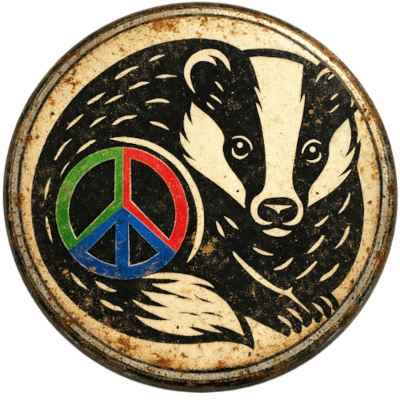

Molesworth People's Peace Camp and badges
Established in the early 1980s, the Molesworth People's Peace Camp became a unique site of resistance to the deployment of US cruise missiles on British soil, blending Christian witness, peace movement direct action, and creative protest.
Established in the early 1980s, the Molesworth People’s Peace Camp became a unique site of resistance to the deployment of US cruise missiles on British soil, blending Christian witness, peace movement direct action, and creative protest.
The cruise missile decision and first acts of witness
The decision in 1980 to house 64 Ground-Launched Cruise Missiles at RAF Molesworth transformed the sleepy Cambridgeshire base into a major focus of protest. In May 1981, a symbolic act of resistance took place when members of the Fellowship of Reconciliation-on a cycle pilgrimage from Iona Abbey to Canterbury Cathedral-visited the then-unfenced site. The Bishop of Huntingdon, Gordon Roe, planted a cherry tree to mark the occasion.
Later that year, on Holy Innocents Day (28 December 1981), a coalition of Christian activists, including members of the Fellowship of Reconciliation, Christian CND, and Green CND, established a peace camp at the south-east gate of the base. Their presence inaugurated what would become the Molesworth People’s Peace Camp &mdsdah; a community of protest dedicated to peace and disarmament.
A diverse and inclusive peace community
Unlike the women-only peace camp at Greenham Common, Molesworth’s camp was mixed, including women and men, and drew participants from a wide spectrum of beliefs. There was a strong and consistent Christian presence, particularly Quakers, but it also welcomed people of other faiths and of none. This inclusive ethos was embodied in the building of a wooden interfaith chapel named Eirene (from the Greek word for peace), which was a gift from the organisation Architects for Peace.
The camp was first centred around an area known as Peace Corner, on a disused loop of the B660 adjacent to the base. This original camp was evicted in July 1983 but was quickly re-established along Warren Lane bridleway to the west. The Eirene Chapel was dismantled, but work began on a new version on the base itself, built with rubble from the old airfield runway. On Easter Sunday 1984, Satish Kumar laid its foundation stone. Though the chapel was never completed, it stood as a symbol of enduring witness.
Rainbow Village and land-based protest
In August 1984, activists once again entered the base, occupying part of the then-unfenced airfield. This group, later known as the Rainbow Village, included New Age travellers, environmentalists, anarchists, Quakers, and other peace activists. It was a colourful and unconventional community that combined lifestyle protest with direct resistance. The village printed its own publication-the Molesworth Bulletin, using a bender shelter as its press office.
As part of their philosophy of peace and sustainability, the Rainbow Village cultivated a plot of land to grow wheat. In a gesture of international solidarity, the harvest was later sent to famine-stricken Eritrea. This act demonstrated the community’s broader vision: not just opposition to war, but the creation of practical alternatives to militarism.
The 1985 eviction and military fortification
On 6 February 1985, the Ministry of Defence launched a full-scale operation to retake RAF Molesworth. Around 1,500 troops and police were deployed to secure the perimeter, in what became one of the most dramatic anti-nuclear confrontations of the decade. Soldiers had been rehearsing the rapid deployment of a three-metre-high Dannert wire fence, backed by a five-metre-wide concrete roadway and an additional ten-foot Weldmesh steel fence. Floodlights were installed every 100 yards, and the perimeter was placed under constant armed patrol.
The Secretary of State for Defence, Michael Heseltine, arrived by helicopter wearing a camouflage jacket over his business suit, a theatrical gesture that underscored the militarised response. Roads were blocked with lorries carrying construction equipment, and within days, the base had been transformed into a fortress. The total cost of the operation exceeded £6.5 million.
The only structure left standing within the wire was the half-built Eirene Chapel, begun by peace activists Tim and Bridie Wallis. It remained fenced off until its demolition by the authorities on 14 April 1986.
The mole as symbol of persistent resistance
Throughout the campaign, protesters made creative use of the word “Molesworth” by adopting the image of the mole as a mascot and metaphor. Moles-those quiet, unseen diggers-became emblems of underground resistance. Cartoon moles wearing hard hats and holding peace signs featured on posters, patches, banners, and flyers. Their humble persistence contrasted with the might of military machinery, and they served to remind both protesters and the public that change can be slow, unseen, and determined.
The mole came to symbolise the long, burrowing work of peace activism: difficult to trace, impossible to fully suppress, and always capable of resurfacing when least expected.
Legacy of the People’s Peace Camp
Though the cruise missiles eventually arrived, the Molesworth People’s Peace Camp had a profound effect on public opinion, contributing to the growing resistance that led to the 1987 INF Treaty and the removal of GLCMs from Europe. The protest also helped redefine peace activism in Britain: it was about living the alternative as much as opposing the system.
In later years, the Peace Garden at Molesworth was maintained informally by a network of “Molesworth gardeners.” A memorial sign was erected in 1999 and renewed in June 2019, marking the site not just as a place of protest but as a space of witness, remembrance, and quiet hope.