
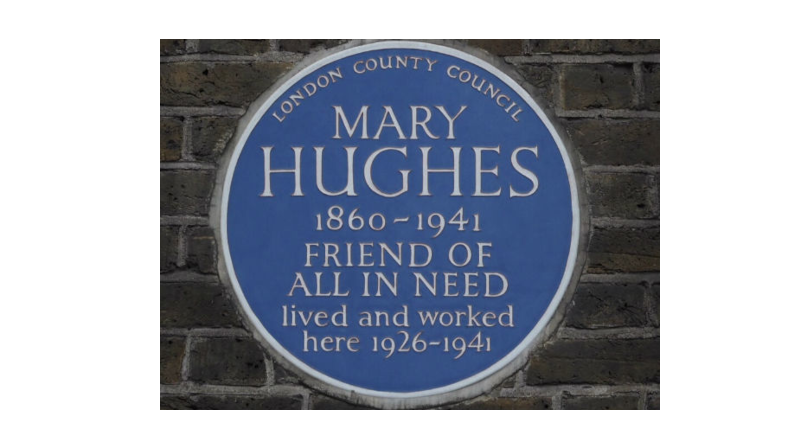
Mary Hughes' blue plaque
Mary Hughes' blue plaque in Whitechapel, London, describes the Quaker social worker as a 'Friend of all in need'.
Mary Hughes (1860 - 1941) was an English social worker in Whitechapel, London. Her father was Thomas Hughes, a Christian Socialist and author of Tom Brown's Schooldays. In 1883, aged 23, she became housekeeper for her uncle John Hughes, a vicar in Berkshire.
In 1892, Hughes joined the local Board of Guardians, which oversaw workhouses in Berkshire. She reportedly caused controversy by suggesting that workhouse residents be allowed tea twice a day instead of once. The resulting argument over a second cup of tea lasted several months, but Hughes eventually got her way.

After her uncle died in 1895, Hughes moved to Whitechapel in 1896 to live with her sister Lilian and brother-in-law, the Rev. Ernest Carter. She soon joined the Stepney Board of Guardians. Her sister and brother-in-law died aboard the Titanic in 1912.
In 1915, Hughes moved to a community settlement in Bow, in buildings that later became Kingsley Hall. She joined the Quakers in 1918 and returned to Whitechapel, living in the Blackwall Buildings. She continued working as a Poor Law Guardian and visiting the local infirmary and children's home.
The Dewdrop Inn
In 1926, Hughes acquired the Earl Grey, an old pub at 71 Vallance Road in Whitechapel. She turned it into a refuge, renaming it the Dewdrop Inn, a pun on 'Do Drop In'.
Hughes slept in a tiny room near the front door, on a padded bench she often gave up to homeless women. She sometimes went without food to feed others and was admitted to hospital more than once with bronchitis after sleeping on the cold stone floor.
A passage about Hughes, written by Howard Spring in 1949, was later included in Quaker Faith & Practice (Chapter 18.3 in fifth edition). A Friend objected to Hughes being described as 'sometimes verminous', but the wording stayed after another declared, “Her lice were her glory!”
Hughes was a well-known local figure in the East End. She would wave her umbrella and step into the road, saying, “The dear trams, they always stop for me.” In 1936, one did not.
After being knocked down, Hughes refused to enter an ambulance until she had written a note, 'It was not the tram driver's fault, it was my fault. Mary Hughes.'
At hospital, when told that she was recovering faster than expected, she sat up in bed and shouted, “Three cheers for vegetarianism and teetotalism!”
Meeting Gandhi
During the 1920s and 1930s, Hughes campaigned for the unemployed, joining marches and rallies. In 1931, when Gandhi visited Britain for the Second Round Table Conference, he insisted on meeting her.
When they met, they clasped hands, looked at each other and burst out laughing. Hardly a word was spoken, but, as one account put it, 'each had recognised the quality of the other's life'.
The blue plaque
In early 1941, Hughes' health began to fail. She was taken to St Peter's Hospital in Whitechapel, where she died aged 81.
In 1961, the London County Council erected the plaque at the former Dewdrop Inn, now a private home, in Vallance Road, recording that Hughes lived and worked there from 1926 to 1941.
Mary Hughes' blue plaque remains today, commemorating the Quaker who was a 'Friend of all in need'.