
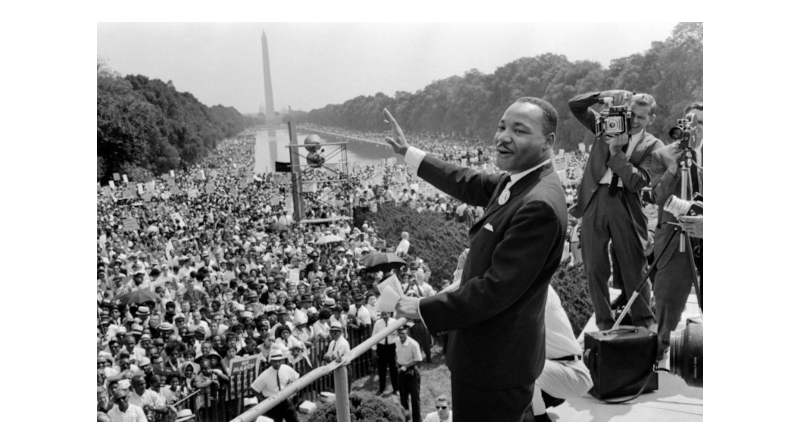
March on Washington for Jobs and Freedom
The March on Washington for Jobs and Freedom (1963) brought more than 250,000 people to the capital, combining demands for civil rights and economic justice in one of the largest and most carefully organised acts of nonviolent protest in U.S. history
Jobs and Freedom
On 28 August 1963, crowds gathered before the Lincoln Memorial in Washington, D.C. They came from across the United States, drawn by demands that were both simple and wide-reaching: jobs, freedom, and equal rights under the law.
The full title matters. This was the March on Washington for Jobs and Freedom. Alongside calls to end segregation and secure voting rights were demands for fair employment, a higher minimum wage, and access to economic opportunity. The march linked racial injustice and economic inequality, presenting them as part of the same problem rather than separate concerns.
More than 250,000 people gathered. The significance lay not only in the number, but in the fact that the crowd held together as a single, directed act.
Timeline
1941
A. Philip Randolph proposes a march on Washington to protest discrimination in defence industries, establishing the idea of mass protest in the capital.
Spring 1963
Civil rights protests intensify, particularly in Birmingham, Alabama, drawing national attention to racial violence.
June 1963
President John F. Kennedy proposes civil rights legislation, but its passage remains uncertain.
28 August 1963
The March on Washington for Jobs and Freedom takes place, bringing more than 250,000 people to the Lincoln Memorial.
1964
The Civil Rights Act is passed, outlawing segregation in public places and employment discrimination.
1965
The Voting Rights Act is passed, securing federal protection for voting rights.
Who organised the march
The march was led by a coalition of civil rights, labour, and religious organisations, including A. Philip Randolph, Martin Luther King Jr., and John Lewis. The central organising role, however, was taken by Bayard Rustin.
Rustin turned the idea of a national demonstration into something that could function in practice. He coordinated transport, structured the programme, organised volunteer marshals, and ensured that the event could operate at scale without losing control. His experience in nonviolent organising shaped the approach throughout.
“We need in every community a group of angelic troublemakers.”
The phrase captures the balance he was working toward. The march needed to apply pressure, but it also needed to remain disciplined enough to sustain it.
Why 1963 mattered
The march took place at a moment of urgency in the civil rights movement. Earlier that year, protests in Birmingham, Alabama, had been met with violence that drew national attention. Images of police repression made clear the scale of resistance faced by those demanding change.
At the same time, President John F. Kennedy had proposed civil rights legislation, but its passage was uncertain. The march was intended to demonstrate public support and increase pressure on Congress.
There was also a longer historical frame. The year 1963 marked one hundred years since the Emancipation Proclamation. The march highlighted the distance between that moment and the reality still experienced by Black Americans.
How the march worked
The scale of the March on Washington created a problem as well as an opportunity. A crowd of this size could easily lose direction. What gave the march its force was that it did not.
This was the result of deliberate organisation. Trains and buses were scheduled across the country. Routes and timings were fixed. Thousands of volunteer marshals were trained to guide participants and maintain order. Attendees were encouraged to remain peaceful and focused throughout.
This approach reflected the principles of nonviolent direct action. The aim was not simply to gather, but to create a visible and sustained presence that would demand a response.
“Nonviolent direct action seeks to create such a crisis and foster such a tension that a community… is forced to confront the issue.”
The march created that tension through contrast: a large, disciplined crowd confronting a system that denied basic rights. Without that discipline, the scale might have been dismissed. With it, the presence carried weight.
The speech and the moment
The best-known part of the march came at its conclusion, when King delivered his “I Have a Dream” speech from the steps of the memorial. John Lewis also spoke that day, representing the younger generation of the movement and giving voice to its urgency.
“I have a dream that one day this nation will rise up and live out the true meaning of its creed…”
The speech gave voice to the aspirations of the movement and has come to define the day in public memory. Yet it stood within a wider structure of speeches, performances, and organised participation.
The moment was powerful because it was supported. The words were heard because the march held.
Impact and legacy
The March on Washington helped build momentum for the Civil Rights Act (1964) and the Voting Rights Act (1965). It demonstrated the scale of support for change and made delay more difficult to sustain.
It also showed how nonviolent direct action could operate at national level. Large numbers alone were not enough. What mattered was the combination of scale and discipline, held together in a way that could not be easily dismissed or ignored.
Rustin’s role sits at the centre of that achievement. He demonstrated that protest could be organised in a way that maintained both pressure and control, turning presence into a form of political force.
The march did not resolve the injustices it exposed. What it did was change the conditions in which those injustices could continue, making them visible at a scale that demanded response and helped force the question of civil rights onto the national agenda.