| | by admin | | posted on 23rd April 2026 | Artworks | | views 1 | |
Let Us Beat Swords into Ploughshares (1959) turns a weapon into a tool through the force of human labour.
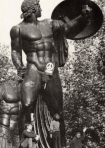
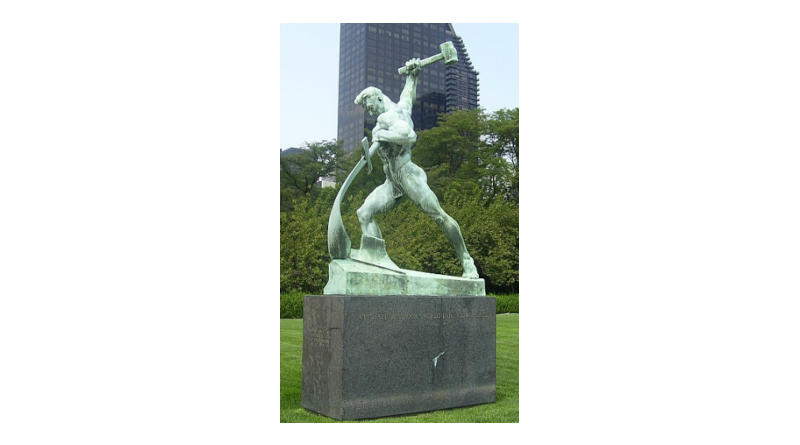
Cast in bronze, mounted on a granite base, and standing over two metres high, the sculpture presents a life-sized male figure in the act of striking metal. His body twists with effort as one hand grips a hammer and the other steadies a sword against an anvil. The moment is not posed but held mid-action, the raised arm about to fall. Every line in the figure directs attention toward the point of contact, where the blade is being forced into a new shape.
The sculptor, Yevgeny Vuchetich, was known for monumental public works that carried clear, state-facing messages. Here, that clarity is immediate. The sword is recognisable, the hammer familiar, the transformation legible. The tension lies in the act itself: a weapon is not discarded but worked upon, its purpose altered through physical labour.
Installed at the United Nations in 1959, the sculpture was presented as a gift from the Soviet Union at the height of the Cold War. It stands within a landscape shaped by nuclear anxiety and geopolitical rivalry, where the language of peace coexisted with the reality of military expansion. The setting gives the work a quiet pressure. It speaks of disarmament while existing within a system defined by arms.
The title draws on a line from the Book of Isaiah, where nations 'shall beat their swords into ploughshares'. In its original form, it is a prophecy, a vision of a future without war. Here, the language is altered. 'They shall' becomes 'let us'. What is promised is turned into something that must be done, shifting the idea of peace from inevitability to effort.
The sculpture has become part of a wider visual language of disarmament, its central image repeated across campaigns, protests and religious movements. Yet what gives it force is not its familiarity but its insistence on process. Peace is not shown as a state but as an action. The figure does not stand in victory or rest; he labours.
Within this, the work aligns with a broader tradition that treats transformation as deliberate and sustained. The biblical phrase, widely used within peace movements, is often read as a vision. Here it is grounded in the body. The act requires strength, repetition and will. The change from weapon to tool is not automatic; it is made.
The sculpture holds a single moment but implies continuation. The hammer has not yet struck, the form is not yet complete. What it presents is not the end of violence but the work required to alter it. In this way, the image resists closure. It does not offer peace as a finished condition.
What remains is the effort itself. The transformation depends on the figure's action, on the decision to act and the force applied to the material. The sword does not become a ploughshare on its own. It is changed because someone chooses to remake it.