How Martin Luther King Jr. got his name
The story of Martin Luther King Jr.’s name reveals an unexpected link between the Protestant Reformation and the modern civil rights movement.
A famous speech and an older story
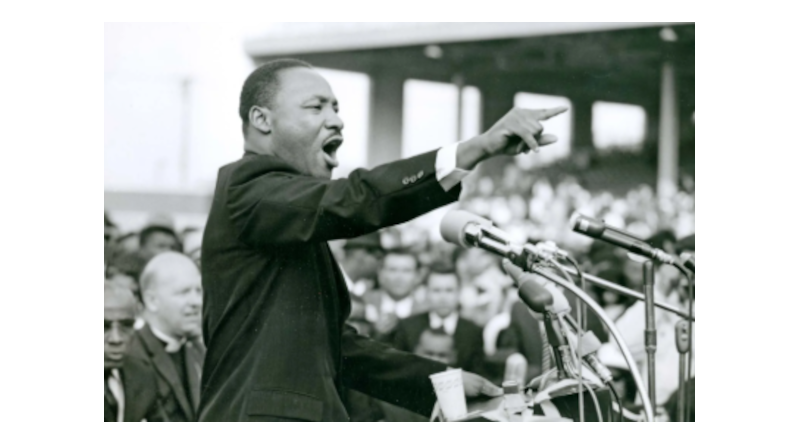
On 28 August 1963 a vast crowd gathered before the Lincoln Memorial in Washington, D.C. When a Baptist minister stepped forward to speak, the words he began would become one of the most famous speeches in modern history.
The man was Martin Luther King Jr. Speaking to the crowd gathered for the March on Washington, he described his dream of a nation where people would be judged not by the colour of their skin but by the content of their character.
King delivered the speech from the steps of the Lincoln Memorial, the monument to the president who had issued the Emancipation Proclamation a century earlier.
Few people realise that even Martin Luther King Jr.’s name carries a story reaching far beyond the civil rights movement. It connects that struggle with a much older moment in European history — Martin Luther and the Protestant Reformation.
The story of how he received that name begins decades before the famous speech of 1963, and its roots reach back more than four centuries.
The name he was born with
Martin Luther King Jr. was not born with the name by which the world now knows him.
When he was born in Atlanta, Georgia, in 1929, his parents named him Michael King Jr. His father, a Baptist minister, was also called Michael King. There was nothing unusual about the name. It was simply the name of a father passed on to a son.
But only a few years later that name would change, and with it the young boy’s place in history.
A journey to Germany
In 1934, Michael King Sr. travelled to Germany to attend a meeting of the Baptist World Alliance in Berlin. During this journey he learned more about the life and legacy of the Protestant reformer Martin Luther.
In 1517 Luther circulated his Ninety-Five Theses in Wittenberg, challenging the authority and practices of the medieval church. His stand helped ignite the Protestant Reformation, more commonly known simply as the Reformation, and established him as a symbol of religious conscience and resistance to authority.
For many Protestants, Luther represented the courage to speak truth even when doing so meant confronting powerful institutions.
Michael King Sr. found Luther’s story deeply compelling. Here was a man who had challenged injustice at great personal risk. When he returned to the United States, he made a decision that would unexpectedly shape the life of his son.
A new name
Inspired by the reformer, Michael King Sr. changed his own name to Martin Luther King.
He also changed the name of his young son.
Michael King Jr., who was about five years old at the time, became Martin Luther King Jr.
“My father was a great admirer of Martin Luther, the Protestant reformer. When I was a child he changed both his own name and mine.”
The boy had no role in this decision. Yet the name his father chose would eventually become one of the most recognisable in modern history.
The change was not initially recorded through a formal legal process. Instead, Michael King simply began using the name Martin Luther King, and the new name gradually became the one by which both father and son were known.
At the time the change was a tribute — a gesture of respect for a reformer whose courage had left a lasting impression.
The meaning behind the name
The name Martin Luther carried an idea of moral courage across centuries.
The reformer Martin Luther, whose actions helped define the Reformation, argued that individuals must follow the voice of conscience, even when this meant challenging powerful authorities.
Four centuries later, Martin Luther King Jr. would speak in strikingly similar language. As a Baptist minister, he stood within a Protestant tradition shaped by that earlier upheaval.
During the civil rights movement of the 1950s and 1960s, King repeatedly argued that unjust laws must be challenged through conscience and moral responsibility.
King’s philosophy of nonviolent protest was also shaped by the example of Gandhi, whose campaigns in India had shown how moral courage and peaceful resistance could challenge unjust power.
“Injustice anywhere is a threat to justice everywhere.”
King did not become a civil rights leader because of his name alone. His leadership grew from the Black church tradition, which for generations had served as a centre of spiritual life, community organisation and resistance within African American communities, as well as from the long struggle for racial justice in the United States and the courage of countless activists who fought for equality.
The story of his name reveals how ideas move through history. The courage associated with the name Martin Luther first appeared during the upheavals of the 16th century. That same name was later adopted by a Baptist minister in 20th century America who admired Luther’s example. When his son grew up to lead a movement for civil rights, the name carried that earlier legacy forward.
Symbols of moral courage
Today the names Martin Luther and Martin Luther King Jr. belong to very different moments in history. One is associated with the religious conflicts of the Reformation, the other with the struggle for civil rights in the modern United States.
Yet both figures became symbols of moral courage in the face of injustice.
The story of how Martin Luther King Jr. received his name is therefore more than a historical detail. It shows how ideas about conscience, justice and faith can echo across centuries.
“One has a moral responsibility to disobey unjust laws.”
In 1517 Martin Luther challenged the authority of his age. In 1934 a Baptist minister in Atlanta chose Luther’s name in admiration. By 1963 that same name would be spoken before the world during the struggle for civil rights.
Sometimes the echoes of history travel in unexpected ways — even through something as simple as a name.