| | by admin | | posted on 11th April 2026 | Artworks | | views 16 | |
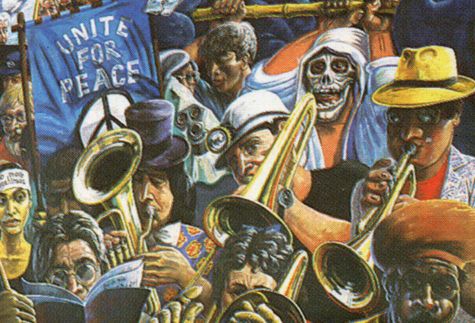
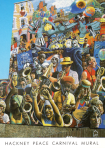
Hackney Peace Carnival Mural (1985) carries a procession of ordinary people forward, where peace is made visible through movement and joy.
The mural stretches across a large wall on Dalston Lane in Hackney, measuring approximately 14 metres by 11.5 metres, and is painted directly onto brick using exterior masonry paint. It presents a dense, forward-moving procession: musicians, dancers, families and activists pressed together in a single, continuous flow. Banners rise above the crowd, some carrying anti-nuclear symbols and campaign slogans, faces turn outward, and the whole composition advances from left to right with an almost rhythmic insistence.
Designed by Ray Walker and completed after his sudden death by Mike Jones and Anna Walker, the work holds a careful balance between individual detail and collective movement. Recognisable figures such as Gandhi and Nelson Mandela appear within the crowd, alongside local residents and symbolic forms. The central tension is immediate: a carnival atmosphere charged with political urgency, where celebration and protest occupy the same space without cancelling one another.
The mural emerged from the 1983 Hackney Peace Carnival, during a period of heightened Cold War anxiety and renewed anti-nuclear activism in Britain, when the threat of nuclear conflict was no longer abstract but widely felt in everyday life. Commissioned as part of the Greater London Council's Peace Year initiatives, it belongs to a moment when municipal politics actively supported cultural expressions of resistance. The carnival itself blended demonstration with festivity, offering a public language able to carry fear, anger and hope at once.
Walker's design was shaped through sustained engagement with the local community, drawing on photographs, conversations and shared experience. His sudden death in 1984 transformed the project, shifting it from a single artist's vision into a collective act of completion. When Jones and Anna Walker brought the mural to life in 1985, they preserved this grounding in lived reality while allowing new references to enter, including the miners' strike and broader critiques of power and greed. The result holds both its original moment and the pressures that followed.
This is not a depiction of peace as absence or resolution. Instead, the mural presents peace as something practised in public, built through presence, visibility and shared action. The inclusion of anti-nuclear symbols, environmental groups and global figures of resistance places Hackney within a wider network of movements, connecting a local street to international struggles.
What gives the work its particular force is its refusal to separate protest from joy. Music, colour and movement are not decorative but essential forms of expression. In this sense, the mural aligns with a broader tradition of nonviolent direct action in which gathering, marching and celebrating become ways of resisting fear. Peace here is not quiet; it is something carried forward by bodies in motion.
Seen at a distance, the mural reads as a single advancing wave. Up close, it breaks into hundreds of gestures, each contributing to the whole. The procession never arrives anywhere beyond the edge of the wall, and yet it does not feel unfinished.
What remains is the sense that peace, in this vision, is not a destination to be reached but a movement to be sustained. The mural does not resolve the tensions it holds; it keeps them in motion, asking the viewer to recognise that moving together may itself be the work.