

Greenham Common Women's Peace Camp
The Greenham Common Women's Peace Camp was a women-led anti-nuclear protest established outside RAF Greenham Common in Berkshire in 1981. Opposing the deployment of US cruise missiles, protesters maintained camps around the airbase, organised mass demonstrations and used nonviolent direct action. The camp continued until 2000, becoming a landmark of British peace and feminist activism.
Sections
Badges
Showing 6 to 6 of 6 total badges
Postcards
Showing 1 to 1 of 1 total postcards
In numbers
36
Women in the original Cardiff peace march, August 1981
120
Miles marched from Cardiff to Greenham Common
96
US cruise missiles designated for Greenham Common
9
Separate peace camps established around the airbase gates
250
Women taking part in the first blockade, March 1982
30,000
Women at Embrace the Base, December 1982
70,000
Estimated protesters in the 14-mile human chain, April 1983
50,000
Women at Reflect the Base, December 1983
19
Years of continuous protest, from 1981 to 2000
Timeline
-
1979NATO agrees to deploy cruise missiles
NATO approved new American missiles for Europe, including 96 cruise missiles at Greenham.
-
1981The Women for Life on Earth march
Women for Life on Earth arrived from Cardiff, establishing a protest outside Greenham.
-
1982The camp becomes women-only
The protesters made Greenham women-only, shaping its feminist identity and independent organisation.
-
1982The first eviction
Bailiffs cleared camp shelters, but the women moved nearby and rebuilt.
-
1982Embrace the Base
Around 30,000 women joined hands around Greenham's perimeter fence in mass protest.
-
1983Dancing on the missile silos
Forty-four women entered the airbase and danced on unfinished missile silos.
-
1983The 14-mile human chain
About 70,000 protesters formed a human chain linking Greenham, Aldermaston and Burghfield.
-
1983The cruise missiles arrive
The first American cruise missiles reached Greenham, despite two years of protest.
-
1983The women surround the base again
Tens of thousands of women returned, cutting fences and protesting missile deployment.
-
1987The nuclear arms treaty
Washington and Moscow agreed to eliminate intermediate-range missiles, including those based at Greenham.
-
1990A legal victory over the byelaws
The House of Lords invalidated byelaws used to restrict protest around Greenham.
-
1991The last cruise missiles leave
The last American cruise missiles departed, while women maintained the peace camp.
-
2000The peace camp comes to an end
The remaining women ended the continuous camp after 19 years of protest.
-
2002The Greenham Peace Garden opens
A memorial peace garden opened at Yellow Gate, commemorating the Greenham women.
Brief history
The missiles and the march (1979 - 1981)
In December 1979, NATO agreed to deploy American cruise and Pershing II nuclear missiles across Western Europe. Britain accepted 160 cruise missiles, with 96 destined for RAF Greenham Common in Berkshire. The decision brought the Cold War arms race directly onto British soil.
In Wales, a group of women formed Women for Life on Earth to challenge the deployment. On 27 August 1981, 36 women, accompanied by several men and children, set out from Cardiff on a 120-mile march to Greenham.
They carried banners, held public meetings and called for a televised debate on nuclear weapons. The marchers arrived on 5 September 1981. After delivering a letter to the base commander, several women chained themselves to the perimeter fence.
Their intention was to draw attention to the danger of nuclear weapons. Instead, their action marked the beginning of a protest that would last 19 years.
A protest becomes a peace camp (1981 - 1982)
Some of the marchers remained outside the main gate, sleeping in makeshift shelters beside the perimeter fence. Supporters arrived with food, blankets and other supplies. What began as a temporary demonstration gradually became a permanent peace camp.
In February 1982, the protesters decided that the camp would be women-only. The decision reflected both practical concerns and a growing feminist understanding of the relationship between militarism, male authority and nuclear weapons. It also gave women a political space in which to organise independently.
The Greenham Common Women's Peace Camp developed without a conventional leadership structure. Decisions were made collectively, and women arrived from different political, social and personal backgrounds. Some remained for a few hours or days, while others made the camp their home.
The original demand for nuclear disarmament remained central, but Greenham increasingly became a place where wider questions about power, gender, violence and nonviolent resistance were openly examined.
Life at the gates (1982 - 1980s)
By the end of 1983, nine separate camps had developed around the airbase, many named after colours of the rainbow. Yellow Gate occupied the original main entrance, while Green, Blue, Violet, Red and other gates developed their own communities and approaches to protest.
The camps were not identical. Red Gate became associated with artists, Violet Gate had a religious emphasis, and Blue Gate attracted women interested in alternative spiritual practices. Green Gate maintained a stricter women-only policy, while several other camps allowed male visitors during the day.
Living conditions were often harsh. Women slept in tents and makeshift shelters known as benders, cooked over open fires and endured cold, rain and repeated disruption.
Supplies depended heavily on supporters, who brought food, clothing, fuel and other necessities. Despite these difficulties, the camps developed their own culture of shared work, discussion, music and political action.
The constant presence of women outside the gates ensured that the nuclear base remained under public scrutiny.
Embrace the Base (1982)
On 12 December 1982, approximately 30,000 women travelled to Greenham for a demonstration called Embrace the Base. Organised through letters, personal contacts and women's peace networks, it became one of the largest women-only demonstrations in British history.
The women joined hands around the airbase's nine-mile perimeter fence. They decorated the wire with photographs of children and families, ribbons, messages and personal belongings.
The fence, intended to separate a military installation from the surrounding community, became a public display of opposition to nuclear weapons. The following day, around 2,000 women remained to blockade the entrances. Many were arrested as they attempted to prevent vehicles from entering or leaving the base.
Embrace the Base transformed Greenham's public profile. The demonstration showed the scale of support for the women living at the camp and established the perimeter fence as one of the most recognisable images of British anti-nuclear resistance.
The fence and the silos (1983 - 1985)
On New Year's Day 1983, 44 women entered the airbase and climbed onto the unfinished cruise missile silos. They danced on the concrete structures, turning a military installation into the setting for an act of nonviolent defiance. All were arrested, and 36 were subsequently imprisoned.
Other actions followed. Women entered the base dressed as snakes and animals, organised mass blockades and cut sections of the perimeter fence. In April 1983, around 70,000 demonstrators formed a 14-mile human chain linking Greenham with the nuclear weapons establishments at Aldermaston and Burghfield.
The first American cruise missiles arrived at Greenham in November 1983. The following month, tens of thousands of women returned to surround the base, using mirrors and cutting sections of the fence in a further mass demonstration.
The fence became both a target of direct action and a surface for political expression. Woollen webs, photographs, ribbons and handmade decorations challenged the purpose of the barrier. Objects associated with domestic life were placed against the machinery of nuclear war.
Evictions and resistance (1982 - 1990)
The women faced repeated attempts to remove them from the land surrounding the airbase. The first major eviction took place in May 1982, when bailiffs and police cleared shelters and possessions. The women moved nearby and rebuilt the camp.
Newbury District Council, the Ministry of Defence and the police continued to challenge the occupation. Shelters were dismantled, belongings confiscated and protesters arrested for blockading entrances, entering the base or refusing to comply with court orders.
The camp also attracted hostility from some local residents and sections of the press. Ratepayers Against the Greenham Encampments campaigned for the women to be removed. The protesters faced harassment, intimidation and, on occasions, physical violence.
Legal resistance became an important part of the campaign. Women challenged the use of byelaws restricting access to the common, and in 1990 the House of Lords ruled that the disputed Greenham Common byelaws were invalid.
The dispute was no longer only about nuclear missiles. It also concerned the right to protest, the use of common land and the powers of public authorities to remove peaceful demonstrators.
Badges of solidarity (1980s)
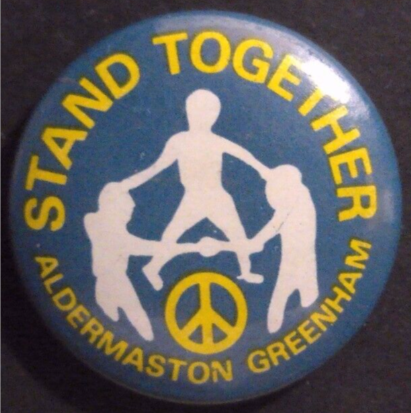
Badges became one of the most visible ways of expressing support for the Greenham women. Their slogans referred directly to the camp, its protests and the determination of those who remained outside the airbase.
Designs included Greenham Women Are Everywhere, I'd Rather Be at Greenham and Fight the Winter at Greenham. Others combined the camp's name with images of doves, women's symbols, spiderwebs and the perimeter fence. The messages ranged from straightforward declarations of solidarity to humour and political satire.
The badges circulated among women at Greenham and supporters elsewhere. Some were sold to raise funds, while others travelled through demonstrations and personal networks.
A Greenham Women Are Everywhere badge made in Britain in 1982 was carried home to New Zealand by a woman who had visited the camp.
Not every badge was necessarily designed or manufactured by women living at Greenham. Support groups and independent campaigners also contributed to the movement's visual identity. Their designs allowed Greenham's message to be worn far beyond the perimeter fence.
Postcards from Greenham (1980s)
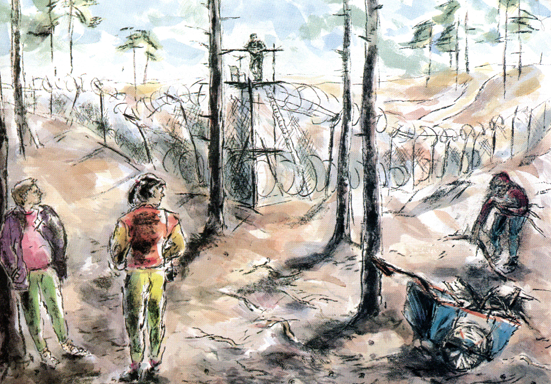
Postcards provided another means of carrying Greenham's images and messages beyond the camp. Photographs recorded demonstrations, decorated fences, women confronting the authorities and the everyday conditions of life outside the base.
Photographer Raissa Page documented the movement extensively. Her images included the December 1982 Embrace the Base demonstration, which was reproduced as a photographic postcard. Such images provided a visual record of events that many supporters had never witnessed directly.
Illustrated postcards developed alongside the photography. Thalia Campbell, one of the women involved in establishing the camp, helped produce banners and political artwork, some of which were reproduced as postcards for sale.
Other artists used photomontage, illustration and satire to communicate Greenham's message. Cath Tate's The Web Spun From Greenham Common, printed by Blackhorse Press, drew upon the spiderweb as a symbol of women's connections and collective action.
Greenham-related postcards also circulated through alternative publishing networks, including material preserved alongside Leeds Postcards in feminist archives.
Postcards could be sent, displayed, sold or kept as records of particular demonstrations. Their illustrations, photographs and printed messages preserved aspects of the campaign that might otherwise have disappeared with the dismantling of the camps.
The missiles leave, the women remain (1987 - 2000)
In December 1987, the United States and Soviet Union signed the Intermediate-Range Nuclear Forces Treaty, agreeing to eliminate an entire category of nuclear missiles. The agreement led to the withdrawal of American cruise missiles from Greenham, beginning in 1989.
The last missiles left the airbase in March 1991. Their removal fulfilled the central demand that had brought the original marchers to Greenham a decade earlier, although the wider political and diplomatic changes behind the treaty extended far beyond the peace camp.
The women did not immediately leave. Some continued campaigning against nuclear weapons, militarism and the restrictions placed upon common land. While several gate camps closed, a smaller community remained at Yellow Gate throughout the 1990s.
In 1997, the former airbase was acquired for redevelopment and the restoration of the common. Large sections of the perimeter fence were removed, and the land gradually returned to public use.
The final protesters departed in 2000, bringing to an end a continuous women's peace presence that had lasted 19 years.
The legacy of Greenham (2000 - present)
Greenham Common reopened to the public in 2000, following the removal of much of the airbase infrastructure. Former military land was restored to heathland, while surviving structures and a memorial garden preserved reminders of its Cold War history and the women's campaign.
The peace camp left an extensive historical record. Photographs, banners, badges, postcards, letters, songs and personal accounts survive in museums, archives and private collections. Together, they document both the major demonstrations and the ordinary work required to maintain the protest.
Greenham also influenced later movements through its decentralised organisation, women-led activism and inventive forms of nonviolent direct action. Its history includes political disagreements, hardship and confrontation, alongside extraordinary commitment and international solidarity.
The women did not end the nuclear arms race. Their presence nevertheless kept the weapons at Greenham under public scrutiny for almost two decades, transforming an airbase perimeter into one of Britain's most enduring sites of peace protest.