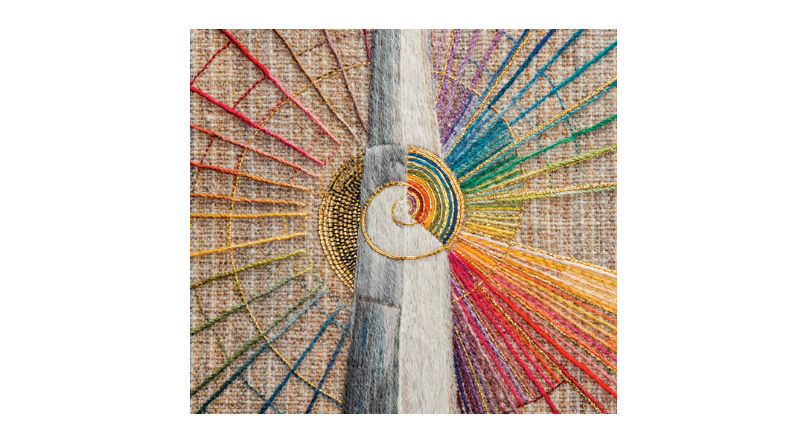
First panel of the Quaker Tapestry
The First panel of the Quaker Tapestry introduces a collection of 77 embroidered panels illustrating over three centuries of Quakerism.
A prism of many colours
At the centre of the first panel is a prism, surrounded by coloured threads spreading out like rays of light. The embroidered words compare the Society of Friends to a prism through which the Divine Light passes, becoming visible in a spectrum of many colours.
The image reflects the diversity of Quaker beliefs and experiences, united by a shared spiritual tradition. It also introduces the tapestry itself, where the lives, achievements and struggles of Friends are told through embroidery, each panel contributing another part of the story.
How the Quaker Tapestry began
British Friend Anne Wynn-Wilson developed the idea for the Quaker Tapestry, taking inspiration from the Bayeux Tapestry and its embroidered account of the Norman Conquest of England.
Wynn-Wilson believed that Quaker history could be told in a similar way, using needlework to illustrate the people, events and beliefs that had shaped the Society of Friends since its beginnings in the 17th century.
The project began in 1981 and grew well beyond its original scope. What started as one Friend's idea became an international undertaking, bringing together Quakers and others who shared an interest in telling the story of the movement.
Rather than producing a conventional written history, the contributors created a series of embroidered pictures in which words, people and events were brought together through colourful designs.
Creating the Quaker Tapestry
Approximately 4,000 men, women and children from 15 countries contributed to the tapestry. Some were experienced embroiderers, while others learned the necessary skills so they could take part.
Despite its name, the Quaker Tapestry is embroidered rather than woven. Its panels combine traditional needlework techniques with a specially developed stitch invented by Anne Wynn-Wilson. Known as the Quaker Stitch, it allowed the embroiderers to create the tight curves needed for the tapestry's distinctive lettering.
Each panel tells a different story from Quaker history, including the experiences of early Friends, the development of Quaker beliefs and the movement's involvement in education, social reform and peace work.
The work continued for many years as panels were designed, stitched and assembled. By its completion in 1996, the Quaker Tapestry had become a collaborative record of more than three centuries of Quaker life, created by thousands of individual contributors.
The Quaker Tapestry today
The tapestry had already found a permanent home in 1994 at Kendal Friends Meeting House in Cumbria, where a selection of its panels became a public exhibition. Visitors could explore Quaker history through the embroidered stories, while individual panels also travelled to exhibitions elsewhere.
For more than three decades, the exhibition introduced visitors to the Society of Friends. However, rising operating costs and financial difficulties forced the Quaker Tapestry Museum to close in December 2025.
The closure did not end the tapestry's public life. In May 2026, volunteers from Kendal Quakers helped reopen the exhibition, allowing visitors to see the panels once again while longer-term arrangements for their preservation and display were considered.
The first panel remains a fitting introduction to the whole undertaking. Its prism transforms a single light into many colours, just as thousands of contributors brought different stories, experiences and skills together to create one embroidered history of Quakerism.