Fallen Leaves
Fallen Leaves (1997-2001) places memory underfoot, where each step becomes part of remembering.
A floor of faces
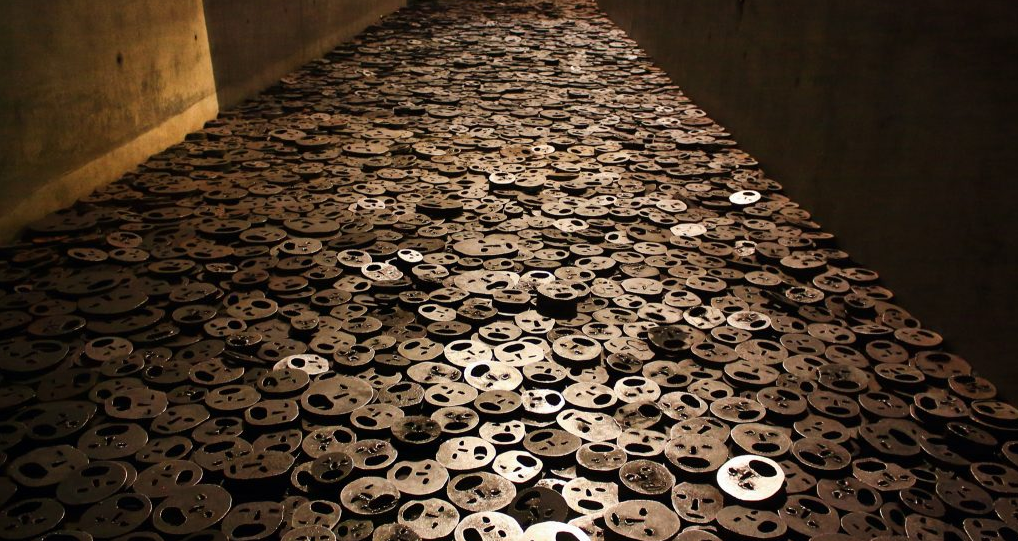
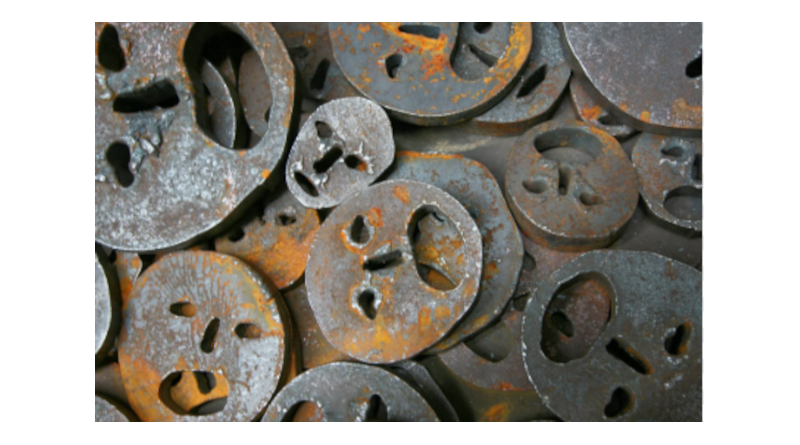
A vast field of circular metal discs fills the floor of a tall, bare concrete space. Each disc is cut into the shape of a face, its features reduced to hollow eyes and an open mouth. The expressions are crude and repeated, yet unmistakably human. As visitors step onto the surface, the discs shift and strike against one another, producing a sharp, echoing clang that fills the void. The sound builds with movement, turning each step into a disturbance that cannot be ignored. The installation spreads across the ground plane of the space, formed from more than 10,000 heavy iron plates, their weight and density contrasting with the fragility of the faces they depict.
The work was created by the Israeli artist Menashe Kadishman between 1997 and 2001. Known for using simplified, repeated forms to explore themes of identity and loss, Kadishman reduces the human face here to its most elemental presence. What we are looking at is not a single image but an environment, one that must be entered and crossed.
A void shaped by absence
The installation sits within the Memory Void of the Jewish Museum Berlin, a space designed by architect Daniel Libeskind to represent the absence left by the destruction of Jewish life in Europe. The void is not a gallery but an architectural interruption, a space that resists completion. Within it, Fallen Leaves does not fill the absence so much as give it a surface.
The Hebrew title, Shalekhet, meaning fallen leaves, introduces a quiet dissonance. Leaves suggest something natural, seasonal, part of a cycle. Here, that idea is rendered in iron, fixed and unyielding. The faces are not scattered lightly but held in place, accumulating into a mass that cannot be brushed aside. While the work is closely associated with the Holocaust, Kadishman dedicated it to all victims of war and violence. This widening of scope does not dilute its meaning, but extends the field of memory beyond a single history.
A witness that cannot stand still
Within peace culture, Fallen Leaves occupies a distinct position. It does not present an image to be observed at a distance, nor a narrative that can be followed from beginning to end. Instead, it requires participation. To move through the space is to step on the faces, to generate the sound, to become part of the work's unfolding. There is no path that avoids this involvement.
This creates a tension between witness and action. The visitor cannot remain neutral. Each step produces noise, a metallic clatter that accumulates into something like a collective voice. The faces do not speak, yet they are not silent. In this way, the work resists the idea of memory as something quiet or contained. It insists on presence, disturbance and the impossibility of passing through without consequence.
What it means to move forward
There is no resolution offered within the installation. The faces remain where they are, the sound continues as long as movement continues, and the space does not provide an alternative route. To stop is to remain within the void. To move is to continue the disturbance. The work leaves the visitor between these positions, neither fully at rest nor fully able to withdraw.
In that tension, the sculpture finds its force. Memory is not presented as something preserved behind glass, but as something encountered through the body. Each step carries forward what it disturbs, extending the work beyond the space itself. The faces remain, but the act of remembering moves on with those who cross them.