
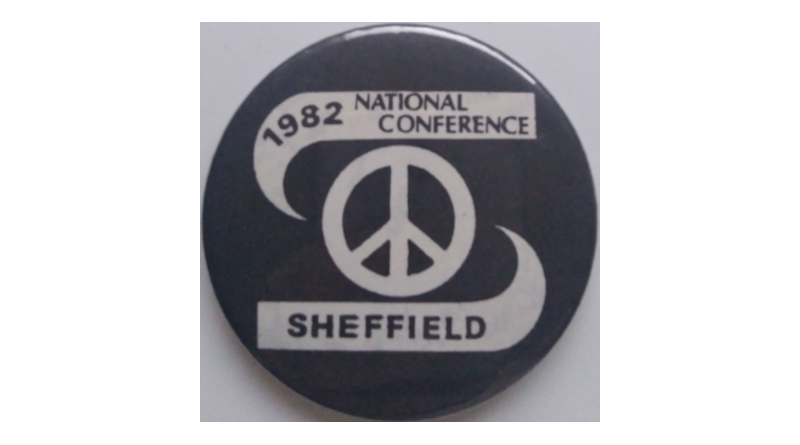
CND National conference, 1982
CND national conference, 1982 is a vintage delegate's pin badge from the Campaign for Nuclear Disarmament's annual conference that year.
The badge is circular and dark grey. At its centre sits a bold white CND peace symbol. Two white ribbon shapes curl around it, one sweeping upward to the right and one downward to the left, each carrying black text. The upper ribbon reads 1982 NATIONAL CONFERENCE. The lower reads SHEFFIELD.
The ribbons do not decorate the symbol. They anchor it to a specific time and place, wrapping the familiar circle and lines inside a civic proclamation.
Held at Sheffield City Hall in November 1982, decisions were waiting on the floor.
The city that said no first
By 1982, national CND membership stood at around 50,000. It would reach 75,000 the following year and 110,000 by 1985. The immediate cause was the announced deployment of US cruise missiles to Greenham Common and Molesworth. Thousands of new members were joining every month.
The movement needed to decide what to do with them. Sheffield was not a neutral choice of venue. David Blunkett's city council had declared South Yorkshire a nuclear-free zone and a demilitarised zone. The red flag flew over the Town Hall on May Day.
The city had signed a peace treaty with Donetsk in Soviet Ukraine. When delegates arrived at Sheffield City Hall, they were walking into a city that had already taken its own position.
Hard Luck
Six weeks before the conference, CND had won a significant fight. The Home Office had planned a national civil defence exercise called Operation Hard Rock, designed to test whether Britain could survive a nuclear attack.
CND renamed it Operation Hard Luck and set about exposing it for what it was: an attempt to convince the public that nuclear war was manageable. Nuclear-free zone councils across the country refused to take part. The government cancelled the exercise in October 1982.
At Sheffield, the cancellation was not simply celebrated. It was used. Delegates formalised resolutions to boycott all future government civil defence initiatives, turning a single campaign victory into standing policy.
The question on the floor
The conference's most contested moment came with a resolution calling for Britain's complete withdrawal from NATO. The CND leadership attempted to water it down. The delegates defeated them. The resolution passed.
With a general election approaching, the leadership chose not to act on it. But the vote was on the record. The membership had spoken more plainly than the leadership had wanted, and Sheffield had heard it.
Dignity and silence
That autumn, a British action film called Who Dares Wins had reached cinemas. Its plot portrayed a thinly disguised CND faction as violent terrorists. Bruce Kent issued national protest guidance to all regional groups.
Demonstrate outside local cinemas, hand out leaflets, do it in complete silence. Give the film no ammunition.
At Sheffield, that guidance was circulated to delegates and formalised as standard activist protocol. The CND national conference badge, 1982 was pinned on at a moment when the movement was large enough to be caricatured and disciplined enough to know exactly how to answer back.