
Darlington Clock Tower
The Darlington Clock Tower was presented to the town in 1864 by Joseph Pease, a Quaker whose family helped shape Darlington.
The Clock Tower in 1864
Joseph Pease was a Quaker industrialist, railway investor and Britain's first Quaker MP. He gifted Darlington two public landmarks, the Old Town Hall in 1853 and the Clock Tower in 1864.
The brick Clock Tower stands beside the Market Hall. Both buildings were designed by Quaker architect Alfred Waterhouse, and the tower has four clock faces overlooking the centre of Darlington.
By 1864, Quakers had lived in Darlington for nearly 200 years and had become influential in banking, industry and education. Sisters Jane Barbara and Elizabeth Procter ran a school for girls that moved to Polam Hall in 1854.
The Quakers of Darlington
In 1662, Darlington had just 15 recorded Quakers. Before the Toleration Act of 1689, Quaker worship was illegal, and Friends risked prosecution for practising their religion. Despite this, Friends purchased a house and land on Skinnergate in 1678 and established a Meeting House.
The Act of Toleration made Quaker worship legal in 1689. Over the following century, Quaker families became increasingly involved in Darlington's trade, banking and manufacturing. In 1774, James Backhouse and his sons Jonathan and James established a bank that helped finance local businesses.
The Stockton and Darlington Railway
One of the most significant changes to Darlington began in the 1820s, when local businessmen sought a cheaper way to transport coal from the Durham coalfields to the River Tees.
Edward Pease, a Quaker merchant in Darlington, became a leading organiser and financial backer of the Stockton and Darlington Railway. He worked with engineer George Stephenson, who persuaded him that steam locomotives offered advantages over horse-drawn wagons.
On 27 September 1825, George Stephenson drove Locomotion No. 1 along the newly opened railway, pulling coal wagons and passenger carriages. The Stockton and Darlington Railway became the world's first public railway to use steam locomotives.
The railway did more than transport coal. It helped establish Darlington as a centre for locomotive building and engineering. Workshops, foundries and associated businesses expanded, bringing employment and helping the town grow.
Darlington Football Club: The Quakers
By the time Darlington Football Club was founded in 1883, Quaker families had been associated with the town for generations. The club became known as 'The Quakers' from its early days, reflecting Darlington's established Quaker identity.
Land at Feethams was leased from Quaker businessman John Beaumont Pease in 1866. It later became Darlington FC's original ground.
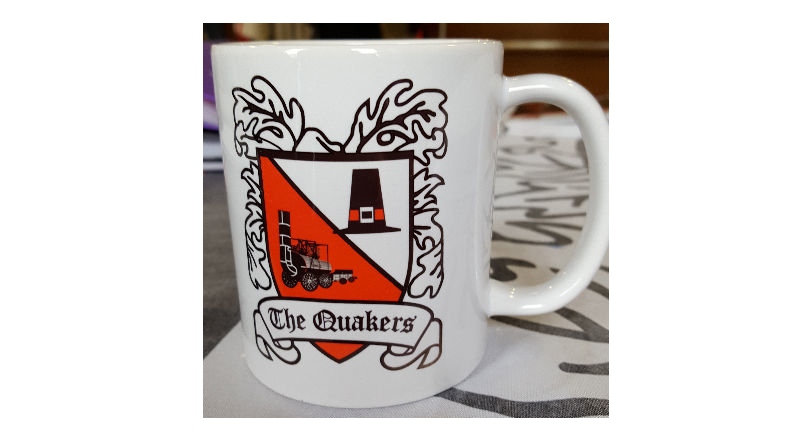
Although Darlington FC has no formal association with the Society of Friends, its nickname became part of the club's identity. Its crest features both a traditional Quaker hat and a steam locomotive, representing two important parts of the town's history.
Darlington's Quaker legacy
On Skinnergate, Friends continue to worship on the same plot of land they purchased in 1678. The original Meeting House was later replaced by the present building, which dates from 1846.
The railway reshaped Darlington, and the football club still carries the nickname 'The Quakers'. Joseph Pease's Clock Tower stands beside the Market Hall, a surviving landmark of the town's ongoing Quaker history.