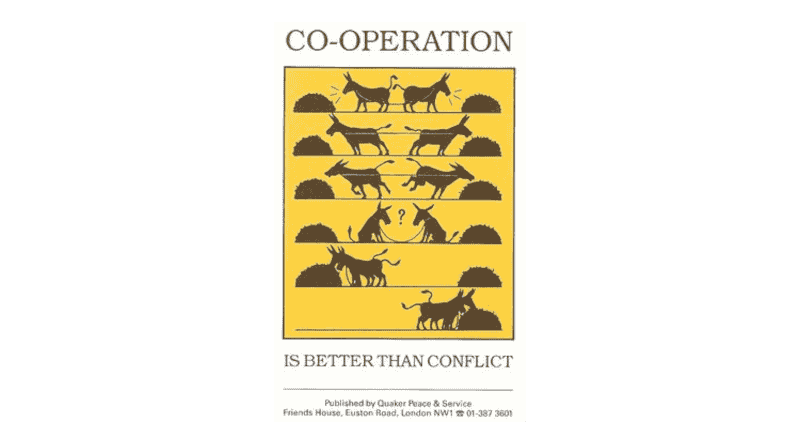
Co-operation is better than conflict postcard
The Co-operation is better than conflict postcard uses two stubborn mules to introduce the Quaker approach to peace education.
The tale of two mules
The postcard tells its story in six drawings. Two mules are tied together by a rope, with a pile of hay beyond each animal. Both pull towards their own food, stretching the rope tight. Neither can reach it.
Pulling harder only makes matters worse. Eventually, the mules stop, turn towards one another and walk together to the first pile. After eating, they move on to the second. The rope has not changed, but their approach has. Neither needs to defeat the other to get what it wants.
The story is simple enough for a child to follow.
A fable for the nations
The original artist and date of the two-mule illustration are unknown. What is known is that before the image appeared on postcards, it was used printed posters by the American Friends Service Committee (AFSC) no later than 1933.
This original use of the image as a poster had the title The Two Mules: A fable for the nations.
In the 1930s, the growing threat of war made cooperation between countries an urgent question. The mules offered a familiar problem on an international scale. Nations pursuing their own interests through confrontation could prevent one another from achieving anything.
An early version of the AFSC poster survives among the former League of Nations archives, now held by the United Nations in Geneva.
The records place it alongside material on 'moral disarmament', an effort to reduce fear, mistrust and hostility between countries as well as their weapons. The archive does not establish that the League commissioned the poster, but its message fitted that ambition.
From poster to postcard
The two-mule poster continued to circulate after the 1930s. Decades later, British Quaker Peace & Service (1979–2001, subsequently renamed Quaker Peace & Social Witness) reproduced the drawing on the postcard featured here.
The postcard uses the more direct title Co-operation is better than conflict. The earlier subtitle invited readers to think about nations, while the postcard's wording could apply just as readily to everyday quarrels.
Quakers and peace education
Quaker involvement in peace education predates modern classroom resources. Around the world, Friends have used publications, conversations and practical activities to encourage peaceful responses to conflict, both in schools and in wider communities.
Peace education does not assume that people will always agree. It teaches ways to handle disagreement constructively through listening, empathy, cooperation, negotiation and nonviolent conflict resolution.
Peer mediation, for example, trains pupils to help classmates talk through disputes and find their own solutions without taking sides.
Contemporary Quaker-supported Teach Peace resources include an activity based on the two mules. Children can explore why the animals' first attempts fail and what changes when they consider each other's needs.
The postcard brings a message once addressed to nations into everyday life &mdsash; small enough to pass from hand to hand and still encouraging people to consider what cooperation could achieve.