
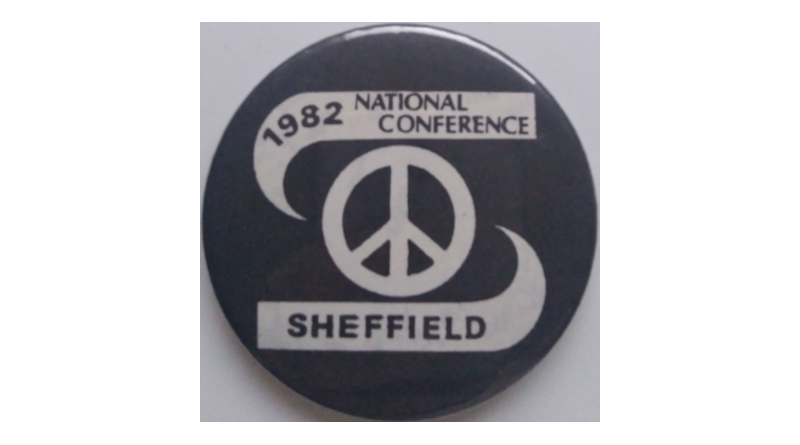
CND National conference, 1982
CND national conference, 1982 is a vintage pin badge from the Campaign for Nuclear Disarmament's annual conference, made in the year the movement reached its turning point.
Why Sheffield?
The peace symbol, by 1982 was everywhere. It was worn on lapels, painted on walls, printed on letterheads, so familiar it had begun to float free of any specific meaning. The specific text and ribbons on the badge stop that, pinning the global symbol to a very specific time and place.
Sheffield, a city that had already decided where it stood, was not a neutral choice of venue. The city council had declared South Yorkshire a nuclear-free zone and a demilitarised zone, part of a broader defiance that earned the city the name the Socialist Republic of South Yorkshire.
The red flag flew over the Town Hall on May Day. The city had signed a peace treaty with Donetsk in Soviet Ukraine. When CND's 1982 conference opened that November, delegates arrived in a city that had already taken its own position.
Hard luck
Months earlier that year, CND had won a significant fight. The Home Office had planned a national civil defence exercise called Operation Hard Rock, designed to test whether Britain could survive a nuclear attack.
CND renamed it Operation Hard Luck, exposing it as an attempt to convince the public that nuclear war was manageable. Nuclear-free zone councils across the country refused to take part. The government cancelled the exercise that July.
At Sheffield, the cancellation was not simply celebrated. It was used. Delegates formalised resolutions to boycott all future government civil defence initiatives, turning a single campaign victory into standing policy.
The question on the floor
The conference's most contested moment came with a resolution calling for Britain's complete withdrawal from NATO. The CND leadership attempted to water it down. The delegates defeated them. The resolution passed by a narrow majority.
The vote did not happen in isolation. The same conference formalised strategies for peaceful direct action at Greenham Common, where the peace camp had been established the previous year.
Arthur Scargill, president of the National Union of Mineworkers, had spoken at affiliated regional rallies in Sheffield in the days leading into the conference, bringing the weight of organised labour to the movement's door.
With a general election approaching, the leadership chose not to act on the NATO resolution. But the vote was on the record. In a steel city with a miners' leader on its doorstep, the membership had spoken more plainly than the leadership had wanted.
Dignity and silence
That summer, a British action film called Who Dares Wins had reached cinemas. Its plot portrayed a thinly disguised CND faction as violent terrorists. Bruce Kent, CND's general secretary, responded with protest guidance to regional groups.
His instruction was plain. Regional groups should demonstrate outside local cinemas, hand out leaflets, and keep silent throughout, denying the film any reaction to feed on.
At Sheffield, delegates circulated that guidance among themselves. The movement was large enough to be caricatured. It was disciplined enough to know exactly how to answer back.
A tin badge for a steel city
By 1982, national CND membership stood in the tens of thousands. It would reach 110,000 by 1985. Thousands were joining every month.
Sheffield was where the movement decided what to do with that growth — not in the abstract, but in resolutions, in boycotts, in silence outside cinema doors.
The city is well known for being a manufacturer of steel. CND national conference, 1982 may be made of tin, but for the people who wore the badge during the event, an unbreakable resolve had been forged.