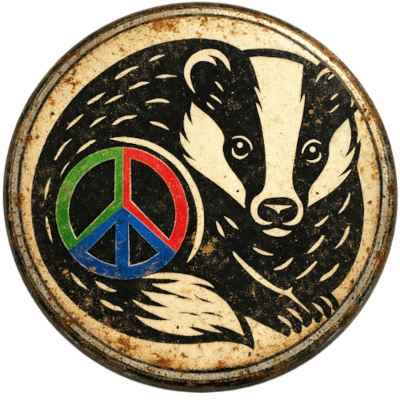

CND: Glastonbury Festival badges
The Glastonbury Festival has a long history of promoting CND and as you'd expect there were lots of badges.
The Glastonbury Festival has a long history of promoting CND and as you'd expect there were lots of badges.
The birth of Glastonbury Festival
The Glastonbury Festival began in 1970 on a dairy farm in Pilton, Somerset. It was the vision of Michael Eavis, who was inspired by the countercultural energy of the time�especially the Bath Festival of Blues and Progressive Music and the spirit of Woodstock.
The first Glastonbury event was a humble gathering. Around 1,500 people attended, paying �1 for entry, which included free milk from the farm. The mood was informal, idealistic, and community-focused�a very different world from the giant festival we know today.
The new age spirit: Glastonbury Fair, 1971
In 1971, Glastonbury evolved into the Glastonbury Fair, shaped by a group of radical thinkers and activists. Among them were Andrew Kerr and Arabella Churchill, who brought a new wave of energy rooted in New Age values.
That year, the Pyramid Stage was constructed�aligned to solstice ley lines and influenced by sacred geometry. Entry was free, and the event celebrated alternative living, spirituality, ecology, and collective creativity. It wasn’t just a music festival; it was a statement.
The CND Years: politics and protest (1981�1990)
In the early 1980s, Glastonbury entered a new phase. It formally partnered with the Campaign for Nuclear Disarmament (CND), weaving protest and activism deeply into its fabric.
Eavis donated ticket proceeds to the CND, which also helped organize stewarding and created dedicated areas for peace education. CND banners and peace signs filled the fields. The Pyramid Stage became a platform not just for music, but for anti-nuclear messages.
The CND symbol: A badge becomes a movement
The CND badge becomes the most iconic peace symbolsin the world.
Originally designed for the Aldermaston Marches, it quickly spread worldwide. By the 1980s, it wasn’t just a protest symbol�it was a pop cultural force, found on everything from banners to tattoos.
Badges at Glastonbury: style and statement
At Glastonbury, CND badges were everywhere. Festival-goers wore them on jackets, bags, hats�anywhere that made a visible statement.
Some badges were simple and stark; others blended the peace symbol with rainbows, feminist signs, or punk aesthetics. They were often handed out or sold at stalls to raise money for the movement. Wearing one was both political and personal.
Radical art and activism in the Green Fields
The Green Fields at Glastonbury became a haven for protest art and radical theatre. Groups like Welfare State International and Earth Circus filled the space with puppets, poetry, and political satire.
Workshops on non-violent resistance, peace rituals, and activism were everywhere. The music, too, reflected this�artists like Billy Bragg, The Smiths, and The Cure often brought messages of rebellion and hope to their sets.
The 1990s onward: a Shift in focus
By the 1990s, as the festival grew in size, the direct link with CND began to fade. Michael Eavis shifted focus to other charities like Oxfam, Greenpeace, and WaterAid.
CND’s physical presence at the festival lessened, but the spirit of peace and protest stayed embedded. The peace symbol, while no longer central, remained scattered across tents, shirts, and signs.
Legacy: Music, Protest, and the Power of Symbols
Glastonbury's connection to CND left a powerful legacy. The festival became more than entertainment�it was a site of learning, activism, and expression.
The peace badge, once a call to action, became a cultural bridge. It still echoes through the festival’s soul today, reminding us that music and resistance can, and often do, go hand in hand.
Badge Timeline
Early 1980s � The beginning of CND at Glastonbury
In 1981 Michael Eavis officially links Glastonbury with the Campaign for Nuclear Disarmament (CND). This is the beginning of CND's strong visual presence at the festival.
CND starts distributing official badges at the festival, often in exchange for small donations.
These early badges often feature plain black-and-white peace symbols, with small text like �Campaign for Nuclear Disarmament� or �Nuclear Disarm Now.�
Mid�1980s � Symbolism and expansion
The badge becomes an essential accessory for many festival-goers, particularly in the Green Fields and CND Peace Camps.
Designs become more varied and colorful, reflecting the broader countercultural spirit�rainbows, psychedelic art, feminist and anarchist overlays on the CND logo.
Many badges are produced in limited local batches, sometimes hand-printed, making each year’s designs slightly different.
Late 1980s � Peak visibility
Badges are everywhere at Glastonbury�on denim jackets, hats, rucksacks, and tents.
CND also produces themed badges for specific festival years, often with �Glastonbury Festival� printed around the edge or integrated into the graphic.
Some badges feature Michael Eavis’s silhouette, the Pyramid Stage, or slogans like �Peace Through Music.�
Early 1990s � Fading but not forgotten
Glastonbury begins to spread its charitable support beyond CND, and their badge production decreases.
Some unofficial or DIY badges continue to circulate, but fewer are directly produced by CND.
By the mid-1990s, the peace badge becomes more of a cultural symbol than a direct activist tool within the festival.