CND Cymru
CND Cymru is a vintage pin badge that uses a national flower to show how the fight against the bomb became inseparable from the defence of Welsh culture
The daffodil and the peace symbol
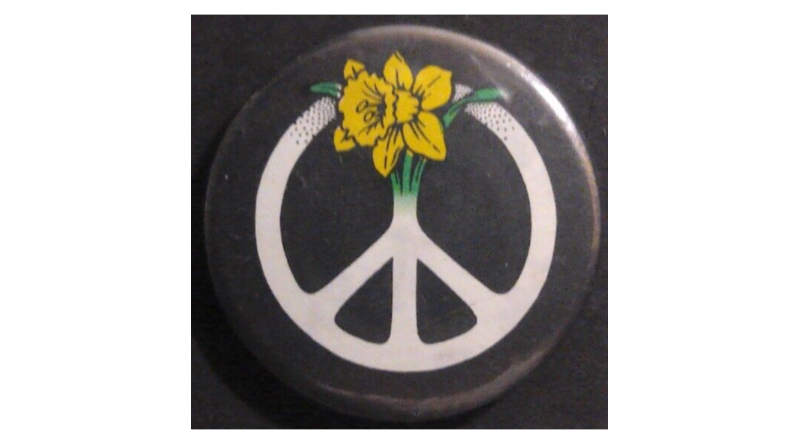
This small, round tin badge uses a stark black background to make its imagery stand out. A thick white peace circle, the universal symbol for nuclear disarmament, dominates the design.
From the centre of the symbol's stark geometry, a green stem rises up, topped by a bright yellow daffodil with distinct petals and a detailed centre.
The green leaves of the flower curve around the top rim of the white circle, breaking the rigid lines of the man-made sign. There is no text on the tin.
The badge makes its statement through this deliberate fusion. It takes an international symbol of protest and roots it firmly in the soil of Wales.
A nation declares its boundary
The design belongs to CND Cymru, the independent Welsh campaign for nuclear disarmament founded in 1981. Activists in towns like Aberystwyth and Cardiff wanted a distinct national voice, separate from the London-directed British movement.
By placing the daffodil at the heart of their campaign, they grounded the abstract fear of atomic warfare in a specific landscape.
By February 1982, this grassroots network had achieved something no other nation had managed. Volunteers had spent months lobbying every local authority across the country.
On 23 February 1982, all eight Welsh county councils signed the Nuclear-Free Wales Declaration. In a quiet but resolute political act, the small nation became the first country in Europe to declare itself a nuclear-free zone.
Women for Life on Earth
The movement was built on physical endurance as well as political organising. In August 1981, a group of Welsh activists calling themselves 'Women for Life on Earth' walked 120 miles from Cardiff to the Royal Air Force base at Greenham Common in Berkshire.
They carried banners through heavy rain to protest the planned stationing of American cruise missiles on British soil. When their initial demands were ignored, they chained themselves to the perimeter fence and established a peace camp in the damp mud outside the base.
That small, women-led protest, started by a walk from Wales, would endure as an iconic symbol of non-violent resistance for almost two decades.
Caneuon Heddwch / Welsh Songs For Peace
Back in Wales, cultural resistance kept the movement warm. In 1985, the independent Welsh record label Sain released a compilation vinyl called Caneuon Heddwch, its cover echoing the same daffodil-and-peace-symbol design as this badge.
The album featured tracks from local folk-rock and pop musicians, who recorded protest songs in support of the peace movement. The project was a powerful statement.
It turned the defence of the Welsh language and the rejection of the bomb into the same sturdy practice, pressing the movement's core beliefs into a physical, musical record.
A Welsh flower for winter
CND Cymru's black background is as stark as the Cold War anxiety of the time. Campaigners called that fear a nuclear winter.
The yellow ink of the flower has not faded. It holds its colour. The daffodil still grows as a vibrant patch of life sprouting out from the symbol for peace.