Carnival Against the Nazis
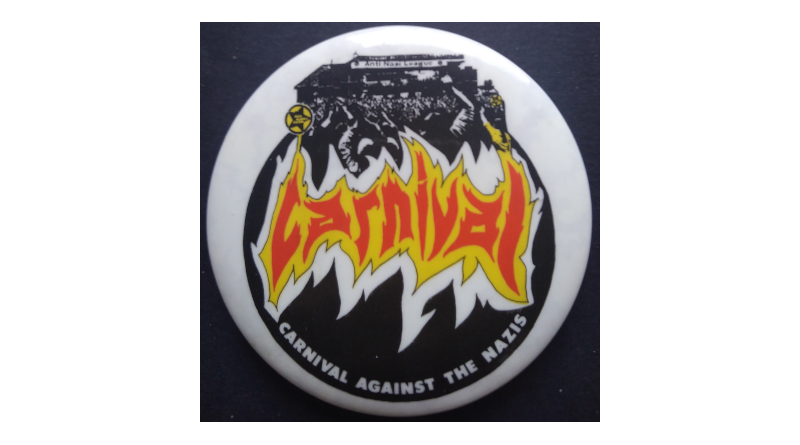
Carnival Against the Nazis is a vintage crossover pin badge between the Anti-Nazi League and Rock Against Racism that celebrates when 100,000 people danced fascism off the streets.
Punk, reggae, and papier-mâché
The Anti-Nazi League and Rock Against Racism organised the day jointly, and it was a logistical mammoth. The plan was to march from Trafalgar Square deep into the East End, ending at Victoria Park in Hackney. It was a deliberate route, driving a wedge of music and solidarity directly into the National Front's heartland.
The organisers had expected maybe 30,000 people to turn up. Instead, an estimated 100,000 arrived. The march was so large that by the time the front of the crowd reached the park gates, the back had not even left the square.
It was not a grim, silent political march. It was a joyful, noisy occupation of space. The crowd brought whistles, steel bands on flatbed trucks, and giant, grotesque papier-mâché heads built to publicly ridicule far-right politicians.
When the march finally reached the park, the concert cemented a historic cultural alliance. Punk and reggae shared the same sound system. The Tom Robinson Band and X-Ray Spex played alongside reggae heavyweights Steel Pulse. The Clash closed with a ferocious set that left the crowd wanting more.
A northern echo and a southern return
The energy generated at Victoria Park was too big to be a one-off event. To prove this was not just a London media stunt, organisers staged two more major carnivals later that year to keep the pressure on.
In July 1978, the Northern Carnival took the movement to Manchester. Fifteen thousand people marched from Strangeways to Alexandra Park, where 25,000 more joined them to watch the Buzzcocks, Steel Pulse, and The Fall.
By September, the movement returned to London for what became known as Carnival 2. This time, the crowds headed south of the river to Brockwell Park in Brixton, drawing another huge audience to see Elvis Costello and Aswad.
The sound of a shifting tide
The 1978 carnivals broke the myth that the far-right owned the streets or youth culture. The sheer volume of people who turned up to listen to rebel music made the racists look small, isolated, and entirely outnumbered.
The blueprint established by these events mixed loud music with hardline anti-fascism. It became a permanent fixture of British protest culture, paving the way for the Love Music Hate Racism campaigns of the decades that followed.
The far-right wanted a race war in the streets of London. The crowd on this badge threw a carnival instead, and danced them out of town.