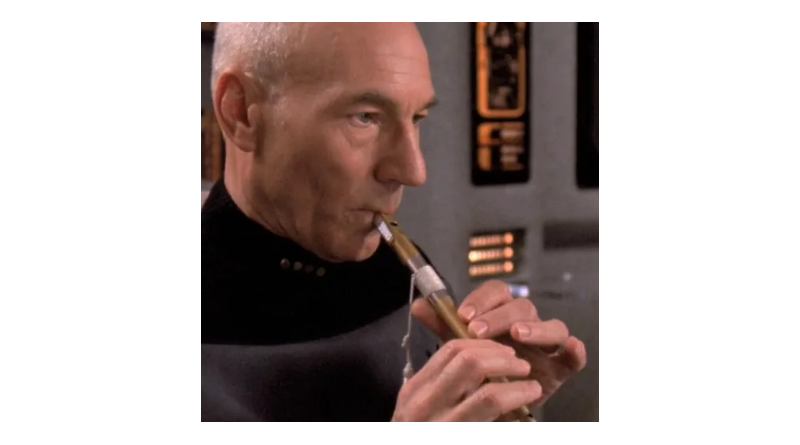
Captain Jean-Luc Picard's Ressikan flute
Captain Jean-Luc Picard's Ressikan flute is a fictional object from Star Trek: The Next Generation that links to the Quaker concept of the Inner Light.
The episode called Inner Light
In the 1992 Star Trek: The Next Generation episode The Inner Light, Captain Jean-Luc Picard is struck unconscious by an alien probe.
While only minutes pass aboard the Enterprise, the unconscious Picard enters a dreamlike experience in which he becomes a man called Kamin on the distant planet Kataan.
Within this altered state, Picard experiences decades of Kamin's life as though they were his own.
He marries, raises a family and grows old within that life. Along the way, he learns to play a small fictional instrument known as a Ressikan flute, which becomes closely tied to his memories of Kataan.
When Picard awakens and returns to his life as captain of the Enterprise, Commander Riker brings him a box recovered from the probe. Inside is a Ressikan flute like the one he learned to play as Kamin. It is the only physical object linking him to a lifetime experienced entirely within.
Why the episode is called The Inner Light
Writer Morgan Gendel took the episode's title from The Inner Light, a 1968 song written by George Harrison for The Beatles. Harrison's lyrics were based on the Tao Te Ching, an ancient Chinese text central to Taoism, a philosophy and spiritual tradition concerned with living in harmony with the Tao, or the natural way of existence.
The song draws on the Taoist idea that understanding does not always come from looking outward. Its 'inner light' is closer to inward knowledge or awareness, which suited Picard's experience of living an entire lifetime within his own mind.
The Quaker Inner Light
Quakers use the same phrase in a different and specifically spiritual sense. The The Spirit is manifested within the individual. From the beginnings of Quakerism, Friends have believed that people can experience the divine directly rather than only through priests, creeds or religious institutions.
The Inner Light should not be confused with simply following personal feelings or doing whatever seems right. Friends listen inwardly for spiritual guidance, but individual leadings are also tested through reflection, experience and the discernment of the wider Quaker community.
This inward experience helps shape Quaker worship. In silence, Friends wait expectantly for The Spirit, which may be experienced as guidance, insight or a sense of how to act. Different Friends may use different language for the experience, but the Inner Light remains one of the best-known ways of describing it.
Returning to the 'real-life' flute
Picard returns to the Enterprise carrying memories of a life nobody else has lived. His Ressikan flute becomes the outward reminder of an inward experience that will remain with him.
For Quakers, the Inner Light is not a memory but an encounter with the divine that helps guide everyday life. What begins inwardly finds its meaning outwardly as an expression of lived faith.