
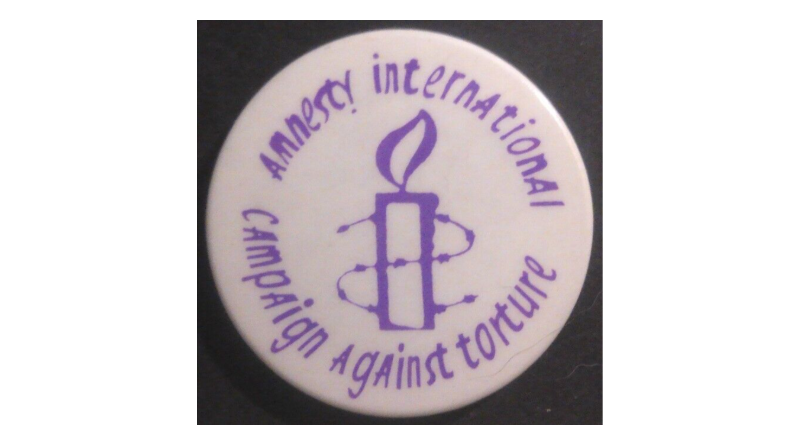
Campaign Against Torture
Campaign Against Torture is a vintage pin badge marking Amnesty International's decision to expand its role into campaigning for the physical safety of prisoners.
The state epidemic
In 1973, Amnesty International launched the Campaign for the Abolition of Torture. Before this date, the organisation had focused primarily on 'Prisoners of Conscience', those jailed solely for their beliefs.
But as the 1970s progressed, they began to uncover a disturbing reality. Torture was not just a medieval relic or the act of rogue sadists.
It was becoming a calculated administrative tool used by modern states to break political dissent.
Sean MacBride, the organisation's chairman at the time, famously described this spread of state-sanctioned violence as an “epidemic.”
This medical language was deliberate, framing torture as a contagion that required active intervention. The timing was tragic but essential. In September 1973, General Augusto Pinochet seized power in Chile.
The subsequent reports of mass detentions and systematic abuse turned the campaign's theoretical fears into a televised reality.
A shoebox of index cards
The global scale of this epidemic stood in stark contrast to the physical reality of the organisation fighting it. When Amnesty International was founded in London in 1961, it relied heavily on volunteer labour and makeshift office equipment.
The massive logistical task of tracking political prisoners across the globe and coordinating international campaign networks was not managed by computers or slick corporate mainframes. It was run using hand-written index cards, meticulously filed and stored inside physical shoeboxes.
This makeshift administration was forced to evolve in March 1973 following the arrest of Luiz Basilio Rossi, a Brazilian professor.
Paper as a shield
When news reached the London office that Rossi was at imminent risk of torture, Amnesty International realised that a standard letter-writing campaign, which often took weeks to organise, would be too slow.
They needed speed. In a scramble of administrative improvisation, staff weaponised their filing system.
Grabbing a shoebox full of index cards containing the contact details of reliable activists, they fired off express telegrams and airmail letters, instructing members to flood the Brazilian authorities with immediate protests.
The sudden influx of international attention forced the police to acknowledge Rossi's custody, likely saving his life. It was the birth of the 'Urgent Action' network — the moment the movement learned that a swift accumulation of paper could act as a physical shield against violence.
Purple ink and jagged wire
The work promoted by the campaign culminated in a massive accumulation of evidence.
In late 1973, the organisation presented a physical mountain of paper to the United Nations General Assembly: a petition with one million signatures demanding that torture be outlawed under international law.
This specific, relentless work against state violence earned Amnesty International the Nobel Peace Prize in 1977.
In 1984, the initiative was officially renamed to simply the Campaign Against Torture.
The badge was pressed to carry this new, urgent name forward.
Featuring Diana Redhouse's iconic 1961 design of a candle wrapped in barbed wire, printed here in rough purple ink, Campaign Against Torture is a lasting tribute to the steady, unglamorous administrative duties of both documenting violence and collecting testimony.