
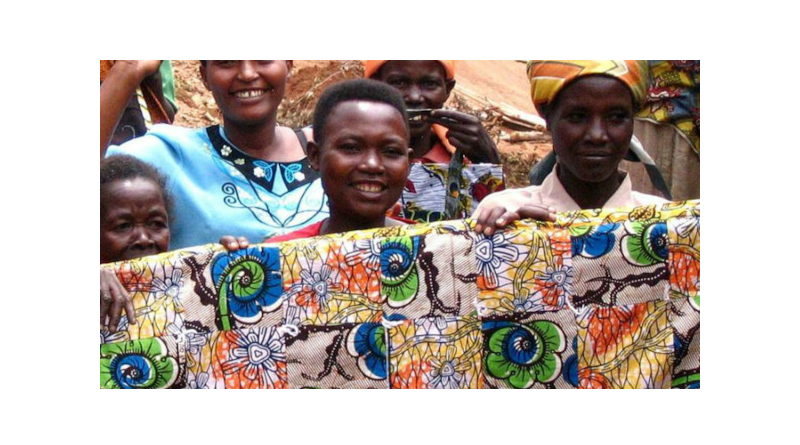
Burundi peace quilt
A Burundi peace quilt is just one of many that are created as a healing art project, co-run by Quakers, for female victims of torture and sexual violence.
Peace Through Pieces
Peace Through Pieces, an outreach project by North Seattle Friends Church, has made this possible. It works in conjunction with Trauma Healing and Reconciliation Services of Burundi (THARS), plus Friends in Burundi and Congo Yearly Meetings.
Patty Federighi, Director of Quilting Ministries for North Seattle Friends Church, explains:
“We started working with THARS about six years ago after an initial visit to Burundi to see if the women were interested in learning quilt making and to find out if the materials and supplies needed for quilt making were available in this extremely poor country. Both questions were answered with a resounding 'Yes!'”
Central Africa has suffered decades of war, leaving huge numbers of people, most of them women, with direct experience of violence.
To make the programme self-sufficient, supporters have provided sewing machines, thread, and other craft tools and materials. This is so the women can make and sell their own items.
How Quakerism in Africa began
Before the 20th century, Quakerism had a scattered history in Africa. Dutch whalers, who were themselves Quakers, first arrived in Cape Town in 1728, though it was not until 1906 that the city's Meeting formally joined London Yearly Meeting.
It would be nearly two centuries before Quakerism took hold elsewhere on the continent.
In April 1902, Cleveland Meeting in the United States sent three Friends, who set sail from New York for Mombasa, Kenya, in East Africa.
From Mombasa, the three Friends went by rail to the end of the line in what is now Kisumu, Kenya. There, they sought the advice of the British colonial administration on where local people had not heard the gospel.
The British authorities directed them north, up a steep escarpment, into forested hill country that would become known as Kaimosi. By the end of summer, the Friends had founded a mission.
Until then, there had been only a few Quakers across the entire African continent. The mission in Kenya would be the beginning of Quakerism's growth in Africa.
By the early 1940s, medical facilities had grown up alongside the mission, and in 1942 Friends launched the Bible Institute. Quakerism was taking root across the country, and the mission expanded further with an epilepsy colony, an agricultural college and a college of technology, as well as many new churches.
Quakerism, by now, was spreading to the neighbouring East African countries of Uganda and Tanzania.
Present-day Quakerism in Africa
Like Philadelphia in the United States and Cumbria in England, present-day Kaimosi remains the historic centre of Quakerism in Africa.
There are around 400,000 Friends across the world and roughly a third live in Kenya, with Kaimosi having the greatest concentration. Unlike in the West, where numbers are in steep decline, Quakerism in Africa is growing, as shown by the spread of countries with meetings:
- Burundi
- Congo
- Ghana
- Kenya
- Nigeria
- Rwanda
- South Africa
- Tanzania
- Uganda
The majority of African meetings are programmed; however, Cape Town Meeting remains unprogrammed in keeping with its British roots. This same African fellowship of Friends is what carries a Burundi peace quilt, stitched by hand, into the arms of a woman beginning to heal.