
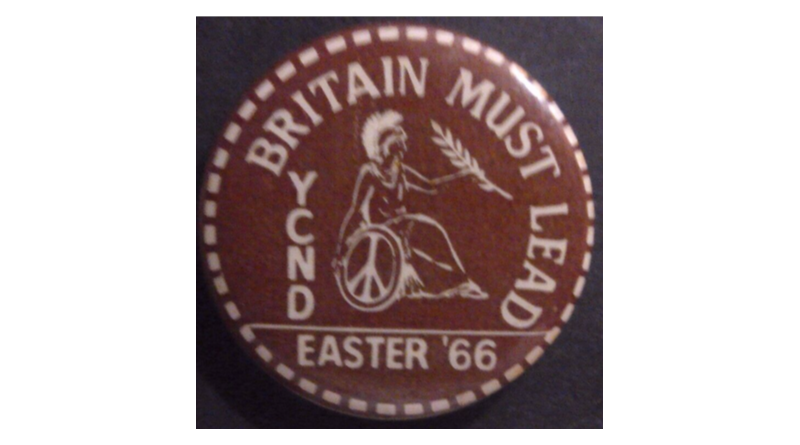
Britain must lead
Britain must lead is a Youth CND vintage pin badge that subverts the familiar figure of Britannia from a symbol of the state into a statement for peace
Britannia and the peace shield
This badge is printed in a deep, earthy brown ink against a cream background. A dashed white border runs around the outer edge, giving the badge the appearance of a postage stamp. In the 1960s, peace movements used this stamp aesthetic to symbolise the delivery of a message.
Inside this border sits the figure of Britannia. She wears a classical gown and an ancient helmet adorned with a jagged, feathered crest. Her right hand holds a leafy olive branch aloft, while her left rests on a large, round shield. The stark lines of the nuclear disarmament symbol have been placed directly onto the face of her shield.
The slogan ‘BRITAIN MUST LEAD’ arcs over the top, with the letters ‘YCND’ running down the left-hand side. The date ‘EASTER ‘66’ is stamped firmly across the bottom, connecting the badge directly to that year's famous Easter protest.
The pre-decimal penny and the trident
The badge's mockery is a direct assault on a figure people carried in their pockets every day. On the reverse of every copper pre-decimal penny was the image of a stately, seated Britannia, her heavy shield resting by her side and the sharp, three-pronged trident held firmly in her hand. She was the official symbol of the establishment, representing not just naval power and the remnants of empire, but also economic stability and the authority of the state.
The unknown artist systematically dismantled that familiar image of serene power. They swapped the maritime trident, an instrument of violence, for a simple olive branch. Most strikingly, they took her shield, a tool of war, and repurposed it as a canvas for the modern lines of the CND symbol.
By rewriting these ancient visual motifs, the badge suggests that Britain's true protection lies not in weapons of mass destruction, but in the global pursuit of total disarmament.
The youth of High Holborn
The letters ‘YCND’ anchor the badge firmly to the Youth Campaign for Nuclear Disarmament, the energetic junior wing of the movement. Based out of an office in High Holborn, London, this group represented a generational shift. By the mid-1960s, many young activists were breaking away from the older, more cautious CND committees, demanding a more direct and visible challenge to the state.
The badge’s design reflects this radical break. The choice of deep, earthy brown mimicks the colour of the copper pre-decimal penny it subverted—was a deliberate move away from the rigid, institutional black-and-white graphics of earlier CND badges. This new generation was coming of age under the shadow of the escalating war in Vietnam, and for them, the slogan took on an urgent, anti-imperialist tone.
This earthy, unconventional badge was their attempt to strip the national symbol of its old colonial baggage and rebrand British identity as a force for international solidarity.
The road to Trafalgar Square
The Easter march of 1966 was different from previous years. In a deliberate reversal of the traditional route, thousands of people started their walk at the Atomic Weapons Research Establishment at Aldermaston.
For four days, they walked the tarmac roads from the bomb factory in Berkshire all the way to the centre of London. The march was a physical act of carrying a message from the source of the weapons to the seat of political power. It culminated in a sprawling rally that filled Trafalgar Square, bringing the protest directly to the government's doorstep.
A new kind of strength
The slogan arcing over Britannia’s helmet, ‘Britain Must Lead’, was a direct call for unilateral nuclear disarmament. Instead of waiting for complex multi-nation pacts, activists demanded that the UK unconditionally dismantle its own nuclear stockpile first. They argued that the moral force of this example would compel global superpowers like the United States and the Soviet Union to follow suit.
This was a clever co-opting of post-imperial patriotism. It appealed directly to a public grappling with a declining empire by suggesting a new global identity. The message was clear: while Great Britain could no longer lead the world through colonial rule or military force, it could still lead morally by being the first nuclear power to reject atomic weapons.
Ultimately, Britain must lead represents a generational break. It is the moment a new generation of activists declared that the old symbols of empire no longer represented them. By hijacking Britannia, they announced that a nation's identity is not a fixed monument, but a living argument that must be constantly challenged and remade from the ground up.