
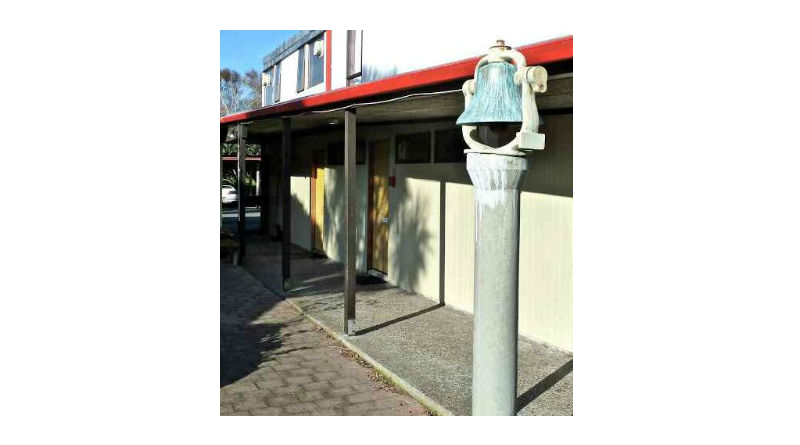
Bell at the Quaker Settlement
The Bell at the Quaker Settlement provides an introduction to the history of Quakerism in Australia and New Zealand.
The bell's journey
The bell's journey began in Pennsylvania, where a railway company vice president donated it to New Zealand Friends' School in Whanganui. Ruby and Edward Dowsett, working with Philadelphia Quaker Arthur Silver, helped arrange the gift. Philadelphia Quaker children raised the money needed to transport the bell across the Pacific in 1950.
When the main building of what was then Holdsworth School was demolished in 1982, the bell was given to the nearby Quaker Settlement for safekeeping.
By the time the bell reached New Zealand, Quakerism had already been established in Australia and New Zealand for more than a century, with small groups of Friends gradually developing into organised religious communities.
Quakerism in Australia
The first Quaker known to have set foot in Australia was Sydney Parkinson, a botanical illustrator who accompanied Captain James Cook aboard HMS Endeavour in 1770. His visit was brief, however, and organised Quaker worship would not become established until several decades later.
In 1832, two English Quakers, James Backhouse and George Washington Walker, arrived in Australia. They travelled through the British colonies, visiting convict settlements, investigating the treatment of Aboriginal people and bringing scattered Friends together for Meetings for Worship.
Their work helped establish lasting Quaker communities in Tasmania and mainland Australia. By 1861, London Yearly Meeting had formally recognised Meetings in Hobart, Melbourne and Adelaide.
As Quakerism developed, Friends established schools and became involved in peace work and social reform. In 1964, Australian Friends formed an independent Yearly Meeting, reflecting the growth of Quakerism from a handful of scattered individuals into an organised religious community.
Quakerism in New Zealand
Across the Tasman Sea, Quakers began settling in New Zealand during the 1840s. The first regular Meeting for Worship was established in Nelson in 1842, followed by the country's first Quaker Meeting House in 1853.
Early Friends often lived far apart, making it difficult to maintain contact and organise worship. Ann Fletcher Jackson, who arrived from England in 1879, travelled widely to visit isolated Friends and helped establish a network of Meetings, including one in Auckland in 1885.
Quakers also use the Māori name Aotearoa, commonly translated as 'land of the long white cloud', reflecting their respect for the country's indigenous language and culture.
During the 20th century, New Zealand Friends became increasingly involved in education, peace work and opposition to military conscription. In 1920, they opened New Zealand Friends' School in Whanganui, providing education based on Quaker values of simplicity, cooperation and respect for each individual.
The school served generations of children, many from non-Quaker families, before closing in 1969. Its closure eventually made possible a new use for land retained by Friends.
The Quaker Settlement
In 1975, Friends established a trust to develop part of the former school land as a residential community. The Quaker Settlement, locally known as Quaker Acres, began taking shape in 1976 on 20 acres of land on the outskirts of Whanganui.
The settlement brings together individual homes around a communal seminar centre, where Quakers and other visitors gather for courses, retreats and meetings. Residents share responsibility for maintaining the grounds, organising activities and managing the community.
Land is held by a Quaker trust rather than owned individually, with residents encouraged to regard themselves as guardians rather than owners. Decisions are made cooperatively through Quaker processes of spiritual discernment, while sustainable living and care for the environment remain important concerns.
The bell has been used to call people back from outdoor work and gather them for shared meals. Originally sent across the Pacific through the generosity of Philadelphia Friends, it found a new purpose in a community built around cooperation and shared responsibility.