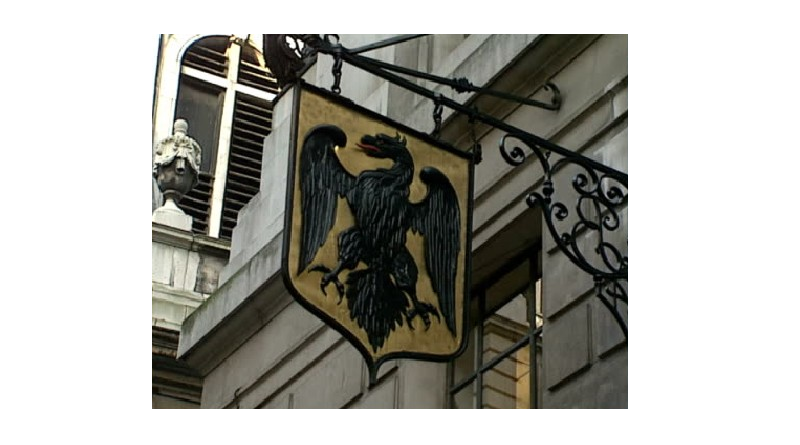
Barclays Bank's Black Eagle sign
The Barclays Bank Black Eagle sign is a reminder of the bank's Quaker beginnings and the wider influence of the Society of Friends on British banking.
The original Black Eagle sign
During the 17th and 18th centuries, London businesses were often identified by signs hanging outside their premises. Before street numbers became commonplace, these signs helped customers find individual shops and traders.
Literacy was not universal, and the City Council of London stated, “Shopkeepers shall hang out signs at theire shopps.”
Lombard Street, a centre of London's goldsmith trade, was particularly well known for its signs. Among them were a Bible and a Black Spread Eagle, which would eventually become associated with Barclays Bank.
In 1728, a Quaker banking partnership moved to larger premises in Lombard Street. As the business expanded, it occupied neighbouring properties identified by the two signs.
The Bible was thought inappropriate for a Quaker moneylending business, so the eagle was retained, eventually becoming the emblem of Barclays Bank.
The goldsmith trade
The bank's origins go back to 1690, when two Quakers, John Freame and Thomas Gould, established a goldsmith business in Lombard Street. Freame dealt in silver from Welsh mines, transporting it to London and selling it to the Royal Mint for coinage.
Goldsmiths did more than deal in precious metals. They also provided secure storage for money and valuables, arranged loans and issued receipts for deposits. These services gradually developed into what would become modern banking.
Quakers had developed a reputation for honesty and fair dealing, which gave their businesses a commercial advantage. Their close networks of Friends helped establish trust between merchants, while the Society of Friends expected its members to maintain high standards of conduct.
Dishonest business practices could lead to disciplinary action or even disownment from the Society. Although this provided no guarantee of financial security, it helped strengthen the reputation of Quaker bankers.
In 1736, James Barclay, a fellow Quaker who had married Freame's daughter Sarah, joined the business. The partnership became known as Freame and Barclay.
Quaker influence on British banking
Barclays was far from the only successful Quaker bank. The Lloyd family established a banking business in Birmingham, the Gurneys became prominent bankers in Norwich, and the Backhouses developed their own bank in Darlington.
During the 18th and 19th centuries, Quaker families became a significant force in British banking, establishing businesses that would eventually form some of the country's largest financial institutions.
In 1896, Freame and Barclay's successors joined 19 other banks, many with Quaker connections, to form Barclay and Company Limited. The new bank had 182 branches and employed 806 staff.
However, as these family businesses expanded into national banking institutions, their direct Quaker involvement gradually diminished. By the end of the 19th century, relatively few of the partners remained practising Friends.
The Black Eagle today
The old hanging signs of Lombard Street fell out of fashion during the 19th century but were revived to mark the coronation of Edward VII in 1902. The Black Eagle once again hung outside the bank.
The eagle itself also underwent changes. Three silver crowns were added in 1937, and during the 1960s its traditional black colouring gradually gave way to blue, which became Barclays' official colour in 1970.
In 2005, Barclays moved its headquarters from Lombard Street to Canary Wharf. The hanging Barclays Bank Black Eagle sign, by this time a reproduction of the 18th century original, was removed.
Today, along with the Black Eagle sign, Barclays Bank has long since lost any direct Quaker connections.