
Backhouse banking crisis of 1819
In 1819, a Quaker bank in Darlington faced a deliberate attempt to force its collapse, revealing how early banking depended on trust, speed, and moral reputation before modern safeguards.
In 1819, a Quaker bank in Darlington faced a deliberate attempt to force its collapse, revealing how early banking depended on trust, speed, and moral reputation before modern safeguards.
Banking before safety nets
In the early 19th century, banking in Britain operated without the protections now taken for granted. There was no deposit insurance, no central bank acting as a reliable lender of last resort, and little formal regulation of country banks. Confidence mattered more than balance sheets, and gold mattered more than promises.
Most banks were private partnerships, issuing their own notes and holding only limited reserves of gold or silver. A sudden demand for redemption could bring down even a sound institution. In this fragile financial landscape, Quaker banks were prominent, trusted, and vulnerable.
The Backhouse family and Quaker banking
The Backhouse family of Darlington were Quakers whose banking business grew out of trade, finance, and a reputation for integrity. By the early nineteenth century, Backhouse’s Bank had become one of the most respected country banks in the north of England. Its standing rested not on size, but on trust - the belief that its notes would always be honoured.
Jonathan Backhouse (1779-1842) was central to the bank’s operation. Like many Quaker bankers, he combined commercial skill with a strong sense of moral responsibility. His bank was solvent, cautious, and well regarded, yet in 1819 it found itself facing a sudden and dangerous threat.
An engineered run on the bank
The crisis of 1819 did not arise from panic among ordinary depositors. Instead, it was deliberate and targeted. A powerful local figure, commonly identified in later accounts as the Earl of Darlington, attempted to undermine Backhouse’s Bank by quietly gathering large quantities of its notes.
The intention was simple and ruthless. If all the notes were presented at once for redemption in gold, the bank would be unable to respond quickly enough. Failure to pay would destroy confidence, triggering wider panic and collapse. By modern definitions, this was a bank run, engineered rather than spontaneous.
A race against time
When Jonathan Backhouse learned of the plan, he acted immediately. He travelled to London to secure gold reserves that would allow the bank to meet any demand for redemption. Speed was essential. Delay could mean ruin.
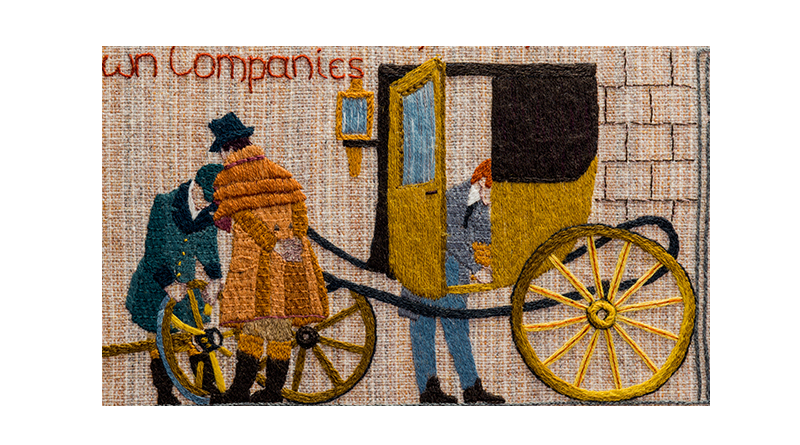
On the return journey to Darlington, disaster nearly struck. Near Croft Bridge, the carriage carrying the gold lost a wheel. Stopping to repair it would have cost precious time. According to repeated local accounts, Backhouse redistributed the weight of the gold to balance the remaining wheels and continued the journey on three wheels.
Meeting the challenge
Backhouse arrived in Darlington in time. When the gathered notes were presented for redemption, the bank paid out in gold. Confidence held. The attempted run failed, and the bank survived.
What mattered was not merely the gold itself, but the visible demonstration of reliability. By meeting the demand calmly and publicly, Backhouse’s Bank reaffirmed its reputation. Trust was preserved not through secrecy, but through action.
Was this a bank run?
Although the term “bank run” was not used at the time, the episode closely matches what would later be recognised as one. There was a coordinated attempt to force mass redemption, driven by confidence rather than insolvency. The danger lay not in the bank’s accounts, but in perception and timing.
In this sense, the Backhouse crisis belongs to a long history of confidence-based banking crises stretching back centuries. What makes it distinctive is its clarity and human scale, and the way it exposes how banking relied on physical reserves and rapid decision-making.
Quaker values under pressure
The episode reveals how Quaker values operated under stress. Honesty, preparedness, and responsibility were not abstract ideals; they were practical tools. The bank survived because its managers believed deeply that obligations must be met, whatever the inconvenience or cost.
At the same time, the story exposes the fragility of early ethical banking. Even a respected Quaker institution could be threatened by hostility, rivalry, or manipulation. Moral reputation offered no immunity from financial attack.
Why the story matters
The Backhouse bank run matters because it shows how early banking really worked. Stability depended on trust, speed, and personal action rather than systems or safeguards. It also illustrates why later reforms - central banking, regulation, and deposit protection - became necessary.
For Quaker history, the episode offers a revealing moment. It shows Friends operating at the sharp edge of capitalism, attempting to act justly within a system that could turn hostile without warning. In the end, the survival of Backhouse’s Bank was not just a financial victory, but a reaffirmation of the idea that trust, once earned and actively defended, could still prevail.