
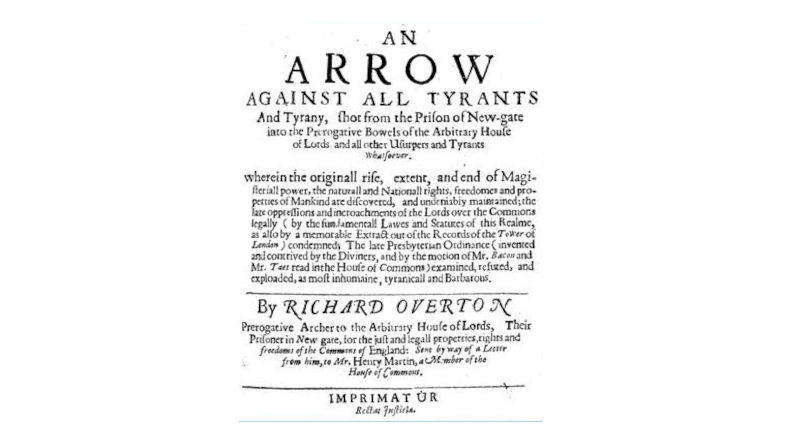
An Arrow Against All Tyrants and Tyranny
An Arrow Against All Tyrants and Tyranny is a pamphlet published in October 1646, by the imprisoned dissenter Richard Overton.
Richard Overton
Little is known for certain about Richard Overton’s early life. The earliest pamphlets attributed to him appear around 1640–1642 and include satirical attacks on church reforms. Mockingly, he wrote on his pamphlets that they should be sold at:
“The shop in Toleration Street, at the sign of the Subjects’ Liberty, right opposite to Persecuting Court.”
During the English Civil War Period (1642 – 1651), Overton became a Leveller and took up the imprisoned John Lilburne’s case against the House of Lords in An Alarum to the House of Lords, published in August 1646. The pamphlet was condemned and Overton was promptly arrested. Refusing to acknowledge the Lords’ jurisdiction, he was held in Newgate Prison.
Like Lilburne, Overton continued publishing from prison, arguing for individual rights and what he described as the nation’s liberties. The best known of his prison works is An Arrow Against All Tyrants and Tyranny, which begins:
“An arrow against all tyrants and tyranny, shot from the prison of Newgate into the prerogative bowels of the arbitrary House of Lords and all other usurpers and tyrants whatsoever. Wherein the original, rise, extent, and end of magisterial power, the natural and national rights, freedoms and properties of mankind are discovered and undeniably maintained.”
Overton also called on the New Model Army to intervene against what he saw as a corrupt Parliament. He took early steps towards linking civilian Levellers with army agitators by highlighting soldiers’ grievances.
Leveller supporters sustained a campaign of petitioning, which helped secure the release of Overton and Lilburne in the autumn of 1647. After meetings with agitators in London, they travelled to Ware in Hertfordshire to support the Leveller mutineers.
Two years later, in 1649, Overton and Lilburne co-wrote An Agreement With the People, now among the best known of the Levellers’ texts. Overton was again imprisoned in 1659, and a further warrant for his arrest was issued in 1663.
After this, his name fades from the record and his fate is unknown.
Full text of An Arrow Against All Tyrants and Tyranny
Sir,
To every individual in nature is given an individual property by nature not to be invaded or usurped by any. For every one, as he is himself, so he has a self-propriety, else could he not be himself; and of this no second may presume to deprive any of without manifest violation and affront to the very principles of nature and of the rules of equity and justice between man and man. Mine and thine cannot be, except this be. No man has power over my rights and liberties, and I over no man’s. I may be but an individual, enjoy my self and my self-propriety and may right myself no more than my self, or presume any further; if I do, I am an encroacher and an invader upon another man’s right - to which I have no right. For by natural birth all men are equally and alike born to like propriety, liberty and freedom; and as we are delivered of God by the hand of nature into this world, every one with a natural, innate freedom and propriety - as it were writ in the table of every man’s heart, never to be obliterated - even so are we to live, everyone equally and alike to enjoy his birthright and privilege; even all whereof God by nature has made him free.
And this by nature everyone’s desire aims at and requires; for no man naturally would be befooled of his liberty by his neighbour’s craft or enslaved by his neighbour’s might. For it is nature’s instinct to preserve itself from all things hurtful and obnoxious; and this in nature is granted of all to be most reasonable, equal and just: not to be rooted out of the kind, even of equal duration with the creature. And from this fountain or root all just human powers take their original - not immediately from God (as kings usually plead their prerogative) but mediately by the hand of nature, as from the represented to the representers. For originally God has implanted them in the creature, and from the creature those powers immediately proceed and no further. And no more may be communicated than stands for the better being, weal, or safety thereof. And this is man’s prerogative and no further; so much and no more may be given or received thereof: even so much as is conducent to a better being, more safety and freedom, and no more. He that gives more, sins against his own flesh; and he that takes more is thief and robber to his kind - every man by nature being a king, priest and prophet in his own natural circuit and compass, whereof no second may partake but by deputation, commission, and free consent from him whose natural right and freedom it is.
And thus sir and no otherwise are you instated into your sovereign capacity for the free people of this nation. For their better being, discipline, government, propriety and safety have each of them communicated so much unto you (their chosen ones) of their natural rights and powers, that you might thereby become their absolute commissioners and lawful deputies. But no more: that by contraction of those their several individual communications conferred upon and united in you, you alone might become their own natural, proper, sovereign power, therewith singly and only empowered for their several weals, safeties and freedoms, and no otherwise. For as by nature no man may abuse, beat, torment, or afflict himself, so by nature no man may give that power to another, seeing he may not do it himself; for no more can be communicated from the general than is included in the particulars whereof the general is compounded.
So that such, so deputed, are to the general no otherwise than as a school-master to a particular - to this or that man’s family. For as such an one’s mastership, ordering and regulating power is but by deputation - and that ad bene placitum and may be removed at the parents’ or headmaster’s pleasure upon neglect or abuse thereof, and be conferred upon another (no parents ever giving such an absolute unlimited power to such over their children as to do to them as they list, and not to be retracted, controlled, or restrained in their exorbitances) - even so and no otherwise is it with you our deputies in respect of the general.
It is in vain for you to think you have power over us to save us or destroy us at your pleasure, to do with us as you list, be it for our weal or be it for our woe, and not be enjoined in mercy to the one or questioned in justice for the other. For the edge of your own arguments against the king in this kind may be turned upon yourselves. For if for the safety of the people he might in equity be opposed by you in his tyrannies, oppressions and cruelties, even so may you by the same rule of right reason be opposed by the people in general in the like cases of destruction and ruin by you upon them; for the safety of the people is the sovereign law, to which all must become subject, and for the which all powers human are ordained by them; for tyranny, oppression and cruelty whatsoever, and in whomsoever, is in itself unnatural, illegal, yea absolutely anti-magisterial; for it is even destructive to all human civil society, and therefore resistible.
Postscript
Sir,
Your unseasonable absence from the House, chiefly while Mistress Lilburne’s petition should have been read (you having a report to make in her husband’s behalf) whereby the hearing thereof was deferred and retarded did possess my mind with strong jealousies and fears of you that you either preferred your own pleasure or private interest before the execution of justice and judgement, or else withdrew yourself on set purpose (through the strong instigation of the Lords) to evade the discharge of your trust to God and to your country.
And since by the divine providence of God it has pleased that honourable assembly whereof you are a member to select and sever you out from amongst themselves to be of that committee which they have ordained to receive the commoners’ complaints against the House of Lords granted upon the foresaid most honourable petition, be you therefore impartial and just, active and resolute, care neither for favours nor smiles, and be no respecter of persons.
And let even the saying of the Lord, with which I will close this present discourse, close with your heart and be with you to the death. Leviticus 19:15. ‘Ye shall do no unrighteousness in judgement: thou shall not respect the person of the poor, nor honour the person of the mighty, but in righteousness shalt thou judge thy neighbour.’
12 October 1646