
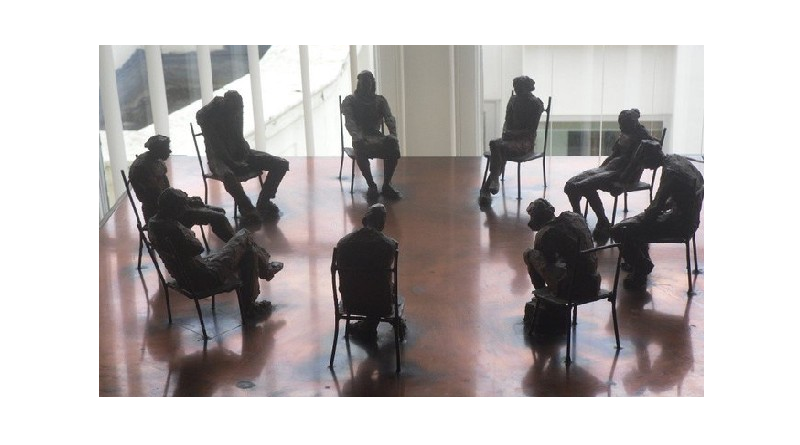
'A Quaker Meeting' sculpture
>'A Quaker Meeting' sculpture<' is a small bronze by the Quaker artist Peter Laszlo Peri, depicting Friends gathered together in shared stillness.
The artist and his sculpture
Peter Laszlo Peri (1899–1967) was a Hungarian-born sculptor who settled in Britain in 1933 after the rise of Nazism in Germany. He later joined the Society of Friends, becoming involved in Quaker life.
Peri was particularly interested in depicting ordinary people and their everyday activities. His work included studies of figures sitting together during Quaker Meetings.
His small bronze sculpture A Quaker Meeting captures Friends gathered in stillness and has traditionally been displayed at Woodbrooke, the Quaker study centre in Birmingham. When Woodbrooke vacated the building in 2023, stewardship passed to the Bournville Village Trust. The sculpture is believed to remain there.
Quaker Meetings
A Quaker Meeting, formally known as a Meeting for Worship, brings Friends together in shared stillness. In the unprogrammed tradition common in Britain, Friends generally sit facing one another, without a priest or minister leading the gathering. Most Meetings last around an hour, although shorter Meetings are also common.
As the Meeting settles into silence, Friends turn their attention inward, setting aside everyday distractions and remaining open to the presence of The Spirit. Some experience a growing sense of peace or clarity, while others find themselves reflecting more deeply on their lives and relationships.
For Friends who believe in God, this stillness may bring a sense of closeness to the divine. Others understand the experience in less explicitly religious terms. Although individual experiences differ, the shared stillness allows Friends to listen inwardly while remaining connected to those gathered around them.
Silence and spoken ministry
Silence is central to an unprogrammed Quaker Meeting, but it is not simply an absence of sound. The stillness creates space for spiritual insight, which may sometimes find expression in spoken words.
Sometimes a Friend feels moved by The Spirit to stand and speak. This is known as spoken ministry and may take the form of a personal insight, reflection or message believed to be worth sharing with those present. After the ministry, the Meeting returns to silence, allowing Friends time to consider what has been said.
The practice reflects the Quaker belief in the Priesthood of All Believers, where no individual holds exclusive authority to speak on spiritual matters. Anyone present may offer ministry, although nobody is required to do so.
Programmed and unprogrammed Quaker Meetings
The shared stillness depicted in Peri's sculpture is characteristic of unprogrammed Meetings, where Friends gather without a predetermined order of service. This approach is common among British Quakers, but practices vary across the worldwide Society of Friends.
Programmed Meetings, particularly widespread in Africa and parts of the United States, may include hymns, readings, prepared sermons and periods of silence. Some are led by pastors, while others combine elements of programmed and unprogrammed traditions.
'A Quaker Meeting' sculpture' captures what can be seen of a Quaker Meeting: people sitting quietly together. What the sculpture cannot reveal is the inward experience of those gathered, where stillness may give rise to spiritual insight, a sense of connection or the guidance of The Spirit.