
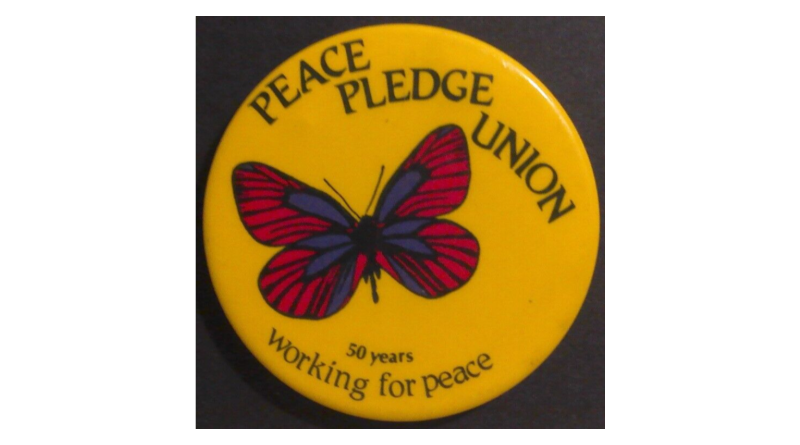
50 years working for peace
50 years working for peace is a vintage pin badge by the Peace Pledge Union (PPU) made for its golden jubilee in 1984.
A five decade-long pledge
On 16 October 1934 the Reverend Dick Sheppard published a historic open letter calling for individuals to pledge never to support another war.
Sheppard died just three years later in 1937. He did not live to see the long-term fruits of his call. Yet, exactly 50 years after that initial letter, on 16 October 1984, the Peace Pledge Union marked its golden anniversary.
On 16 October 1984. the golden jubilee arrived during an escalating Cold War atmosphere. Nuclear anxieties were tangible, and the public landscape was deeply polarised. Rather than looking backward in nostalgia, the group used the anniversary as a platform to confront a volatile world.
Promoting the pledge
A national appeal for members was launched via advertisements in major broadsheet newspapers. The appeal was issued by the classical composer Sir Michael Tippett, who was serving as the President of the PPU in 1984.
Tippett used this high-profile public drive to urge readers to actively sign the core pacifist pledge. For the anniversary he gave a presidential speech in London to the assembled members of the PPU.
His speech examined the sturdiness required of peace work, focusing on the responsibility of the creative artist toward humanity during times of global tension. Crucially, the address expanded the definition of pacifism beyond the simple absence of international warfare.
Tied the traditional stance of the union to contemporary, structural struggles. He spoke directly of civil rights, race relations, and the immediate threat of nuclear escalation.
Peace was framed not as a fragile wish, but as a practical necessity entwined with daily justice. The golden anniversary became a vital opportunity to re-engage a new generation facing modern geopolitical fears.
Revival of the white poppy
The anniversary period also witnessed the mass revival of the white poppy. Originally distributed in large numbers during the 1930s, the practice had waned over the decades. The run-up to the 1984 anniversary saw a systematic effort to reintroduce the white poppy to the British public.
This campaign was paired with the introduction of Alternative Remembrance ceremonies. The emblem served as a visible, quiet declaration of conscience. It anchored the historical witness of 1934 into the modern anti-nuclear movement.
From mourning to celebration
Alongside the revived poppy, the union issued a specific badge to mark the 1984 anniversary. This design broke significantly from its usual visual language. While the white poppy is fixed on a loss already suffered, worn in memory of all the war-dead, the anniversary badge features a butterfly.
This butterfly stands for the PPU itself. Like the organisation, the butterfly is fragile. It carries no armour, and its wings can tear at the lightest touch. Yet it also represents transformation.
What began as a single letter in 1934 grew, over 50 years, into a movement carried forward by everyone who ever signed it. The colours of the badge carried this same charge. Where the white poppy stays muted, this design sets a red and black butterfly against a bright yellow background.
These vivid colours represent future hope rather than past grief.
Britain's oldest secular pacifist organization
By 1984, the PPU had reached the milestone of being as Britain's oldest secular pacifist organisation. The anniversary demonstrated that a commitment to peace could remain steady, unhurried, and resolute across generations.
50 years working for peace celebrates the PPU's golden jubilee as a half-century of ordinary citizens pledging to renounce war — pinning the pledge in place.