
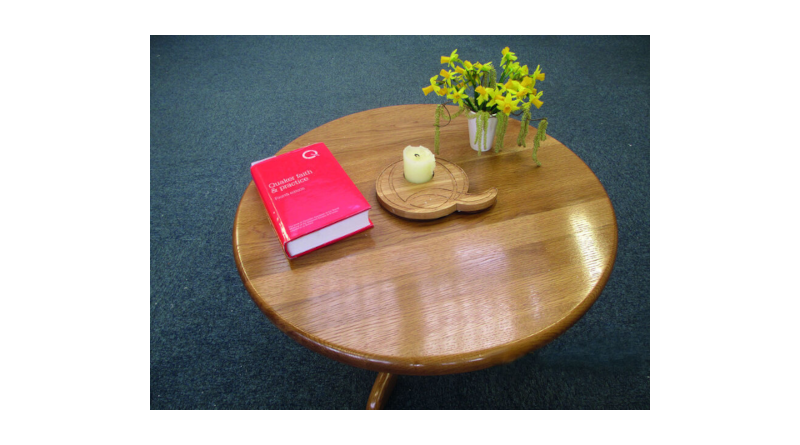
Quaker-led quiet session table
The Silence Inside table was made by a Buddhist prisoner for a multifaith quiet group facilitated by a Quaker chaplain
Made for Silence Inside
The group, called Silence Inside, brings people together for quiet sessions inside a prison. To celebrate its third anniversary, the group commissioned a wooden table from one of its Buddhist members.
He made and polished the small, round oak table in the prison workshop, giving the group something of its own to use during their gatherings. Rather than being supplied by the prison or an outside organisation, the table was made by one of the participants for the benefit of everyone.
The group's cooperation across different faiths reflects an approach that Quakers have brought to prison work for centuries.
Quakers and prison reform
The earliest Quakers knew imprisonment at first hand. From the 1650s, Friends were frequently jailed for practising their religion. Their experiences exposed them directly to harsh prison conditions and helped establish a lasting concern for the treatment of prisoners.
In 1699, Quaker writer John Bellers argued against capital punishment and called for prisoners to receive useful work and opportunities for rehabilitation. In 1724, he urged fellow Friends to become involved in prison reform.
A century later, Elizabeth Fry began visiting women held in London's Newgate Prison in 1813. She organised education and practical support, later giving evidence to Parliament in 1818 about prison conditions and the need for reform.
Other Friends continued visiting prisoners, opposing capital punishment and campaigning for improvements in prison conditions throughout the Victorian period and into the 20th century.
Underlying much of this work was the Quaker belief that there is 'that of God in everyone'. For Friends, the circumstances that brought someone to prison did not remove their right to be treated with dignity.
Quaker work in prisons today
Quaker involvement in prisons continues through chaplaincy, visiting and concern for prison reform. Quaker chaplains offer individual conversations, reflective groups and quiet sessions, working alongside chaplains from other religious traditions.
Their purpose is not to convert prisoners to Quakerism, but to offer spiritual support and a willingness to listen. Prisoners do not need to share Quaker beliefs to participate.
Silence has an important place in Quaker worship, where Friends gather quietly and wait for spiritual guidance. In prison, quiet sessions provide an opportunity for people of different faiths, or none, to share time for reflection without having to agree about religion.
Prisons are often noisy environments where privacy is limited. A quiet session offers a temporary break from the demands of prison life, allowing participants time to sit, think and, when appropriate, speak.
The Silence Inside table provides a simple focus for these gatherings. A candle, flower or book of reflections may be placed on its surface while the group sits together.
What began as an anniversary project became something the group could use whenever it gathered in silence.