
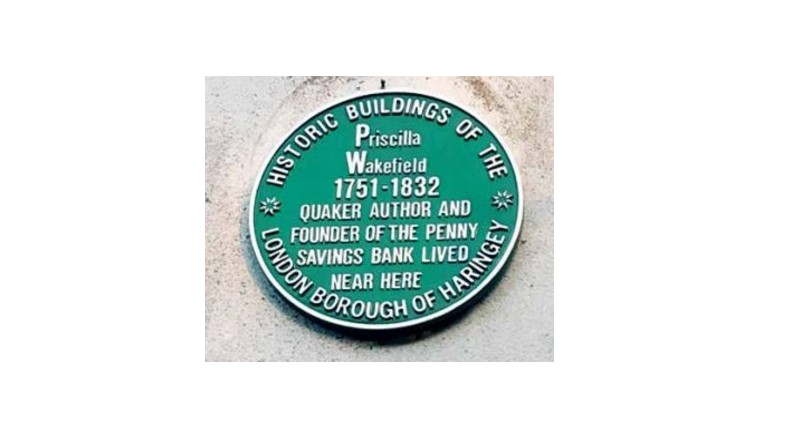
Priscilla Wakefield's green plaque
Priscilla Wakefield's green plaque in Tottenham commemorates a Quaker writer and social reformer who pioneered savings schemes for women and children.
Background and writing career

Priscilla Wakefield was born into a Quaker family in Tottenham, north London, in 1751. She married Edward Wakefield, a merchant, in 1771. When Edward suffered a series of business losses, Priscilla began writing to bring money into the household.
Wakefield published 17 books, including works for children on natural science and botany. Her writing also addressed women's limited opportunities to earn a living, as well as the abolition of slavery and prison reform, causes supported by other Quakers.
Helping women and girls in Tottenham
Wakefield did not confine her interests to books. In 1791, she established the Lying-In Charity in Tottenham, helping around 120 poorer women each year during and after childbirth.
In 1792, she founded the School for Industry, where 36 girls learned reading, writing and arithmetic, as well as sewing and knitting. The school aimed to give girls skills they could use to support themselves.
Women's independence and savings banks
In 1798, Wakefield published Reflections on the Present Condition of the Female Sex. She questioned why women's choices of paid work were so restricted and argued that education could open more possibilities.
Her book engaged with questions about work and wealth raised by Adam Smith in The Wealth of Nations (1776). Wakefield concentrated on the opportunities women could gain through better education and employment.
That same year, she founded the Female Benefit Club in Tottenham. The scheme offered women financial support and an alternative to costly borrowing. Its Children's Bank enabled families to put aside small sums for their children, with deposits starting at just a penny a month.
Wakefield developed the idea further in 1804 by establishing the Tottenham Benefit Bank. It paid 5% annual interest on deposits of £1 or more, making saving worthwhile even for people without large incomes.
The bank's first account belonged to a 14-year-old orphan girl. She deposited £2 that she had saved through the earlier benefit scheme.
Wakefield's initiatives were among the early examples that helped establish savings banking in England. Her writing and local projects shared a practical concern with helping women and children gain greater financial security.
The green plaque
Priscilla Wakefield died in 1832, aged 81, cared for by her sisters after a long career as a writer and social reformer. It was not until the 21st century that Tottenham commemorated her achievements with a green plaque.
Green plaques are part of a scheme commemorating notable people in the London Borough of Haringey, which includes Tottenham. Wakefield's plaque was first unveiled in 2008 at High Cross United Reformed Church, near her former home, Sunnyside.
Her house had been demolished in 1910, so the plaque stands on a nearby church rather than on her former home. Its inscription remembers her as a Quaker author and founder of a penny savings bank.
After the original plaque deteriorated, a replacement was unveiled on 22 October 2018, the 220th anniversary of the Female Benefit Club. Priscilla Wakefield's green plaque remains near the place where Wakefield put her ideas about education, employment and saving into practice.
For more see the external website — Priscilla Wakefield: Tottenham activist