William Penn's peace treaty belt
William Penn's peace treaty belt embodies Lenape diplomatic tradition, early Quaker ideals, and the enduring legacy of the Treaty of Shackamaxon.
The Lenape and their diplomatic world
The Lenape (also called the Delaware people) are an Indigenous nation whose homelands stretched across what is now eastern Pennsylvania, New Jersey, southern New York, and northern Delaware. They lived in extended matrilineal families, formed interconnected village communities, and were deeply rooted in the rivers, forests, and coastal landscapes of the region.
For centuries before European arrival, the Lenape had been respected throughout the mid-Atlantic as peacemakers and mediators, often called “the Grandfathers” by neighbouring nations. Their diplomacy relied on clarity, memory, and reciprocity — qualities embodied in their most important diplomatic objects: wampum belts.
These belts, woven from white and purple shell beads, were not decorative items. They served as records of treaty agreements, promises, historical events, and sacred obligations. The patterns encoded meaning, and the belt itself carried the weight of law. When a belt was exchanged, both sides became responsible for honouring what it represented.
A gift to seal Penn's first agreement with the Lenape
When William Penn arrived in 1682, his first meetings with Lenape leaders drew on this long-standing diplomatic tradition. Influenced by his Quaker principles — especially truth, equality, and nonviolence — Penn approached these councils without weapons, without soldiers, and without coercive demands. Contemporary accounts describe these gatherings as open, respectful, and marked by careful listening.
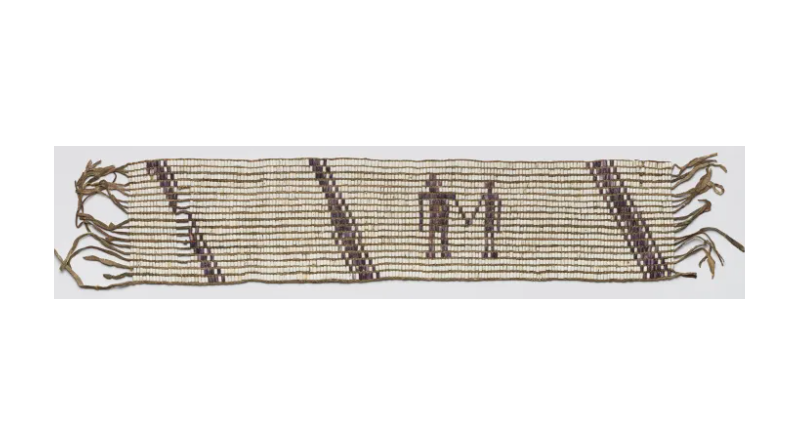
It was during these initial councils, most likely in the same period as the later-named Treaty of Shackamaxon, that Lenape diplomats presented Penn with what is now called the peace treaty belt.
The belt's design is simple but profound: two human figures — one Lenape, one European — standing side by side and holding hands. In Lenape diplomatic language, this image signified equality, friendship, mutual responsibility, and a promise that neither side would wrong the other. It expressed, in visual form, the principle that Penn would later be remembered for: “We meet on the broad pathway of good faith and good will; no advantage shall be taken on either side.”
How the belt relates to the Treaty of Shackamaxon
The Treaty of Shackamaxon — the legendary meeting said to have taken place under a great elm tree beside the Delaware River — occupies a unique place in American and Quaker memory. No written treaty survives, but numerous witnesses and Lenape oral historians agree that Penn pledged to live in peace, fairness, and friendship with the Indigenous nations of the region.
The peace treaty belt is the material counterpart of that agreement. In Lenape diplomacy, words alone never constituted a treaty — a wampum belt was required to formalise and bind the promises. The belt itself became the treaty document, ensuring the agreement would be remembered by future generations.
The imagery of the two linked figures precisely matches the spirit of the Shackamaxon understanding. Even though no paper document exists, the belt operates as the authentic diplomatic record of what was agreed under the elm tree.
What became of the belt
If Penn received the belt — and the historical evidence strongly supports this — it remained in Pennsylvania after his death in 1718. The next part of its history is somewhat fragmented.
It likely passed through private hands in the eighteenth century, and by the early nineteenth century it appeared in Philadelphia collections. Eventually it was preserved at the Philadelphia History Museum at the Atwater Kent.
Although the museum has since closed, the belt remains conserved within Philadelphia's institutional holdings, where it features in research, exhibitions, and discussions about Indigenous rights and colonial legacies. For many Lenape people today, the belt is not merely an artefact but a cultural heirloom, and questions of stewardship and repatriation are increasingly important.
The belt's meaning for Friends today
For modern Quakers, Penn's peace belt carries a dual message. First, it stands as a hopeful symbol — evidence that peaceful coexistence between colonists and Indigenous peoples was not only imagined but genuinely attempted. Penn's dealings with the Lenape reflected Quaker commitments to integrity, equality, and peaceful resolution. For more than seventy years, Pennsylvania experienced relative peace with its Indigenous neighbours, an extraordinary contrast with other colonies.
Second, the belt serves as a sobering reminder. Later generations of settlers abandoned Penn's principles, broke treaty promises, and pushed the Lenape westward. The belt therefore calls Friends to truth-telling about colonial history and to renewed commitment to right relationship with Indigenous nations today.
The belt can be seen as as a symbolic starting point for reflection on the Peace testimony in practice, Indigenous sovereignty and land justice, integrity as a communal discipline, repair and reconciliation, and the responsibilities of living on land shaped by broken treaties.
William Penn's peace treaty belt remains one of the most remarkable objects connecting Quaker history with Indigenous diplomacy. It is a work of memory, a document of cross-cultural understanding, and a challenge to all who encounter it.
Its two linked figures — Lenape and European — still speak: not of a perfect past, but of a shared hope that justice and peace are possible when promises are made with integrity, honoured faithfully, and remembered with humility.