
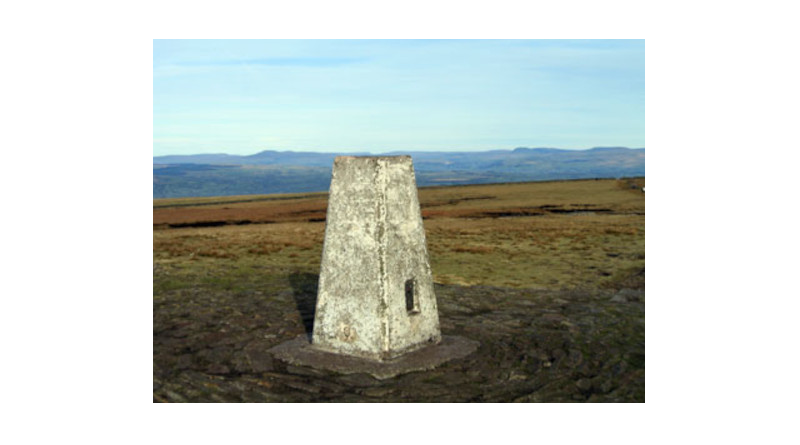
Trig Point Stone on top of Pendle Hill
The Trig Stone on Top of Pendle Hill is a symbolic reminder of both the Quaker faith's origins and its permanence.
At the summit
At the summit of Pendle Hill, battered by moorland winds and silent beneath shifting skies, stands a white-painted concrete pillar: the trig stone. It is a simple triangulation point, once part of the Ordnance Survey network that mapped Britain before the invention of GPS. But for many Friends who make pilgrimage to this place, the trig stone is more than a tool of measurement — it is a quiet marker of a moment when vision broke through clouds, both literal and spiritual.
In what Friends call 1652 country, the young seeker George Fox climbed this very hill. From its peak, he saw what he described as “a great people to be gathered.” That vision became the founding impulse of the Society of Friends. The trig stone stands now where he once stood, anchoring a landscape that has drawn the faithful, the curious, and the oppressed for centuries. It invites not reverence for the stone itself, but remembrance of what it points to: the possibility of inward transformation in a world gripped by turmoil.
A time of turmoil and persecution
The early 17th century in England was marked by religious upheaval, political unrest, and deep social fear. Civil war had recently torn the nation apart, and every corner of society was saturated with anxiety about authority, conscience, and the nature of truth. New sects and movements were rising, challenging the power of church and state alike.
It was in this unsettled world that the Quaker movement was born into a world where speaking openly of direct experience with the divine could lead to imprisonment or worse. For Fox, the religious institutions of the day had failed to satisfy his spiritual hunger. He wandered, listened, questioned. And eventually, on Pendle Hill, he found a sense of divine purpose that would lead him to proclaim a new way: one grounded in the Inner Light of God in all people.
The shadows of Pendle
Pendle Hill was already heavy with history long before Fox’s climb. Just four decades earlier, in 1612, the surrounding region witnessed one of the most infamous witch trials in English history. Twelve people, mostly women, were accused of witchcraft and imprisoned at Lancaster Castle. Ten were hanged. Many were poor, some were known healers, and all were caught in a web of fear, local grudges, and state-sanctioned religious paranoia.
These witch trials were not isolated events, but part of a broader pattern of persecution against those seen as “other”-women, dissenters, the poor, and the spiritually unconventional. That same spirit of suspicion would later lead to the persecution of early Friends, who were mocked, jailed, and beaten for refusing to remove their hats, take oaths, or pay tithes to a state church. In this light, Pendle Hill becomes not just the site of a vision, but a place where the forces of control and the freedom of the spirit have long met in tension.
The vision that gathered a people
George Fox’s vision atop Pendle Hill was not of heaven above, but of people-a multitude ready to receive and live by the light within. What he saw was not a doctrine but a movement. This insight birthed a faith that would spread across England and into the wider world, founded on radical ideas: that every person could encounter God directly; that peace and equality were not optional virtues, but divine imperatives.
The trig stone that now marks the summit is a modern feature, unrelated to Fox’s original climb. Yet it has become an unintentional monument. Friends who make the journey often pause there in silence, placing a hand upon the weathered pillar, as if to steady themselves amid the wind. Some read from *Faith and Practice*, others sing or pray. The act is not ceremonial-it is personal, plain, and deeply rooted.
A sacred landscape
Pendle Hill is not holy in the conventional sense. There is no shrine, no relic, no relic-keeper. But for many Friends, it is a place where the veil is thin-a landscape where the divine has been glimpsed. The combination of wild beauty, painful history, and spiritual significance make it a site of layered meaning.
To climb Pendle Hill is to walk into the cloud of unknowing with hope. The trig stone reminds Friends that even the most ordinary object can become a signpost to transformation. As Fox once stood and saw a people to be gathered, so Quakers stand today — still seeking, still gathered, still rising to the symbolic summit of The Spirit.