Tory wreckers can't make me blue
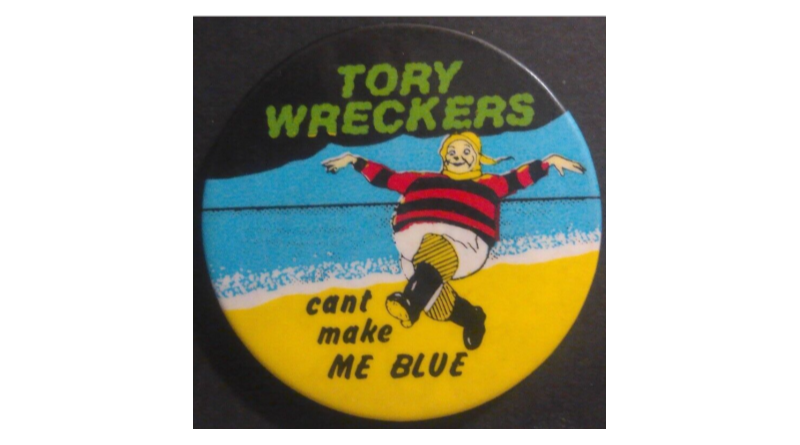
Tory wreckers can't make me blue is a vintage pin badge that subverts a famous piece of British seaside advertising into a pose of political protest.
The Tory wreckers
During the 1980s, Conservative politicians frequently attacked striking trade unionists by branding them 'wreckers' of the British economy. The badge deliberately flips the script, throwing the insult back at Margaret Thatcher's government.
The political left adopted 'Tory wreckers' as a rallying cry. They accused the government of systematically dismantling nationalised industries, public services, and working-class communities across the country.
The slogan printed on the badge offers a defiant double meaning. 'Blue' is the official colour of the Conservative Party, but it is also the universal feeling of depression.
The message to the government was clear. Your policies will never convert us, and your destruction will never break our spirit.
A menace to the establishment
To deliver this message, the badge borrows one of the most famous figures in British advertising. It features the 1908 'Jolly Fisherman' who famously skipped along the beach to promote the seaside town of Skegness.
While he keeps his traditional yellow sou'wester hat and wellington boots, this fisherman has had a crucial wardrobe change. Instead of his traditional blue knitwear, he wears thick red and black hoops.
In British pop culture, this specific jumper belongs to Dennis the Menace, the iconic, anti-authority comic strip character from The Beano.
By dressing the fisherman in this jumper, the badge creator is making a clear visual statement. They are promising to be an absolute menace to this government.
The musical hijack
It is highly likely this badge was originally designed purely as a political statement. However, youth subcultures have a habit of claiming things for themselves.
The badge was quickly hijacked by fans of the 2 Tone ska movement. Buster Bloodvessel, the colossal frontman of the ska band Bad Manners, famously wore that exact same Dennis the Menace jumper on stage.
Because Buster was a large man known for wildly bouncing around and literally 'wrecking' stages, ska fans saw this badge and instantly recognised him.
The political and the musical perfectly aligned. The 2 Tone movement's working-class, anti-establishment ethos naturally overlapped with the anti-Tory sentiment of the era.
Skipping through the wreckage
The Thatcher government's policies left a very real mark on Britain's industrial landscape, closing pits, steelworks, and factories. The 'wreckers' the trade unions warned about fundamentally changed the geography of working-class Britain.
But Tory wreckers can't make me blue refuses to depict that grim reality. Instead, it borrows the uniform of a comic-book menace and the energy of a ska frontman to deliver a message of stubborn joy.
The industries may have been dismantled, but the figure on the tin refuses to stop skipping.