
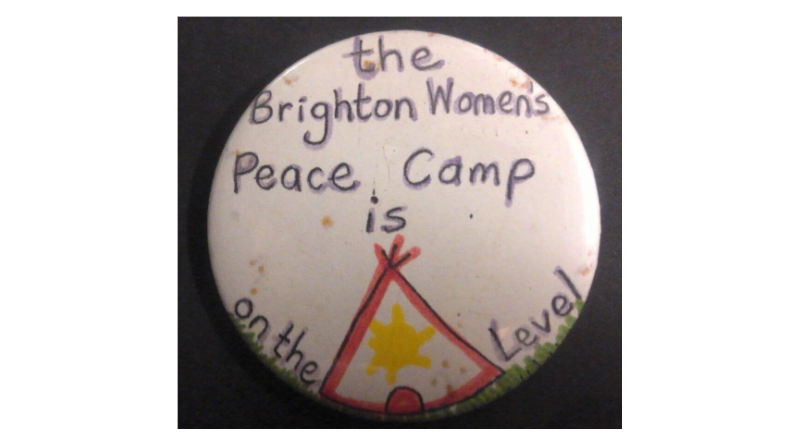
The Brighton Women's Peace Camp is on the Level
The Brighton Women's Peace Camp is on the Level is a vintage pin badge that records a two-month women's peace camp pitched in the heart of Brighton during early 1983.
One person's handwriting
The badge is a small, round, white tin pin. The text is not printed but written by hand in dark ink, in a loose, informal script. It reads: 'the Brighton Women's Peace Camp is on the Level.' A small hand-drawn tent sits at the bottom, coloured in red with a yellow star at its centre, pitched on a thin strip of green.
That handmade quality is not incidental. The camp operated as a non-hierarchical collective, making decisions by consensus in daily circles. No single voice led it. The badge reflects that structure — it has no logo, no organisation name, no professional finish. It looks exactly like what it was: one person's handwriting, pressed into tin.
'On the Level' is a pun. The Level is a flat, open park in the centre of Brighton with a long history of radical public assembly. To be 'on the level' is to be honest and straightforward.
Levelling the land
On 15 February 1983, over a hundred women and children from Brighton's Campaign for Nuclear Disarmament network gathered on The Level and pitched their tents. The previous month, 44 women had been mass arrested at Greenham Common. Brighton's women set up their own camp in direct solidarity.
The Level suited the purpose. Flat, central, and historically associated with public dissent, it gave the camp maximum visibility in the heart of the city. Women gathered daily in consensus circles to organise transport to national protests, run non-violent direct action workshops, and prepare communal meals.
Local residents brought food down to the tents. Oral histories record well-meaning neighbours arriving with large pots of meat-based soup for a community that had quietly committed itself to vegetarianism.
The camp was intended as a brief demonstration. It stayed for over two months.
The police have been very good
At Greenham Common in the same period, bailiffs and police were conducting aggressive, repeated evictions. Women were dragged from fences, their belongings destroyed, their tents pulled down in the mud. Brighton was a different story entirely.
Sussex Police adopted a hands-off approach, monitoring the camp without intervening. Brighton Council, sympathetic to the broader peace movement and already aligned with the national trend of declaring Nuclear Free Zones, chose not to serve trespass notices or pursue legal injunctions.
The women noted the contrast directly. Their recorded statement was plain: 'The Brighton Corporation have been very good. And the police have been very good.'
A forced eviction in a highly visible public park would have generated exactly the kind of publicity the authorities wished to avoid. By treating the camp as a legitimate peaceful demonstration, both the council and the police allowed it to run its natural course.
The friction the women did face came not from the state but from hostile members of the public — right-wing counter-protesters and late-night hecklers who found the camp harder to tolerate than the council did.
Who stands in the circle
The camp was not without its own internal friction. Brighton's women's peace movement was a meeting point for two distinct strands of 1980s feminism. Socialist feminists argued that anti-nuclear work had to be rooted in class politics and connected to working-class communities.
Radical and eco-feminists held that militarism was an expression of patriarchy itself, requiring women-only spaces to counter it. The sharpest expression of that division was practical: who could enter the camp's core living spaces.
Some women welcomed male CND allies for logistical support. Others insisted on a strict women-only boundary within the tents. The daily consensus circles that governed the camp had to hold both positions at once.
The Level lives on
The camp dispersed peacefully in April 1983, but not because it had run out of energy. The Level was a public park, not a military installation. It had no perimeter fence to block, no convoy to stop.
Once the trials of the 44 Greenham women had been publicly witnessed, the core organisers made a deliberate calculation. A peaceful, purposeful withdrawal was preferable to a long, grinding occupation that would eventually collapse under its own weight.
Many of the women who had rotated through the tents — students, mothers, local residents running a shift-work camp between their daily lives — took their training in non-violent direct action and went directly to Greenham Common. The Level had been a rehearsal. Greenham was the frontline.
The pressure of Greenham and its satellite camps contributed directly to the 1987 Intermediate-Range Nuclear Forces Treaty, which mandated the removal and destruction of the American cruise missiles the Brighton women had been protesting against.
The activist networks forged at The Level laid the groundwork for Brighton becoming the heartland of the UK Green Party, electing Caroline Lucas as the country's first Green MP in 2010. The hand-drawn badge, its tent still pitched on a strip of green, is part of that record.