
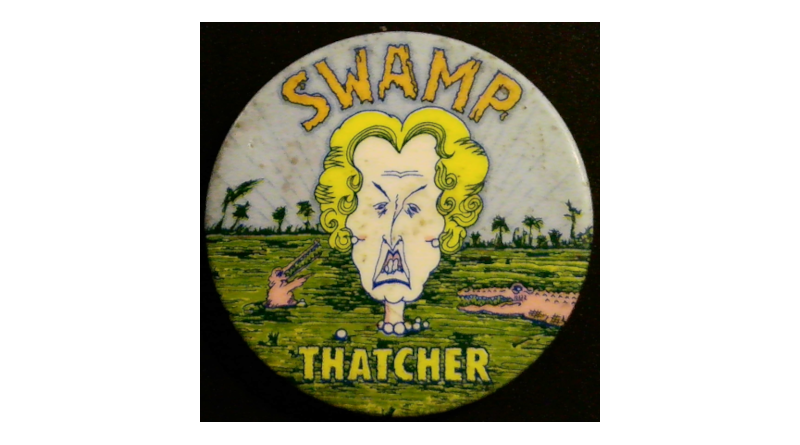
Swamp Thatcher
Swamp Thatcher is a vintage pin badge that acts as a piece of satirical revenge, turning a Prime Minister's own inflammatory language back against her.
A caricature in the marsh
The badge is a small circle of merciless folk art. At its centre is a grotesque caricature of Margaret Thatcher’s head, her face contorted into a furious scowl, her hair a perfect, rigid yellow helmet. She is submerged up to her neck in the stagnant green water of a marsh.
The artwork, by the political cartoonist David Markham, uses a lurid palette of sickly greens and yellows to create a feeling of decay. The word SWAMP hangs above the Prime Minister in a dripping, horror-film font, with THATCHER printed below in the same jagged style.
This is not a passive landscape. Two pink alligators act as agents of menace. One lurks with a toothy grin, while the other sits upright, brandishing a large saw, seemingly ready to get to work. The badge sits firmly in the British tradition of sharp, savage political cartooning, designed not just to mock, but to diminish.
A calculated word on television
The badge’s theme targets a specific phrase Thatcher introduced into the British political landscape. During a 1978 television interview on World in Action, she claimed that many people feared their country "might be rather swamped by people with a different culture."
It was not a casual remark. It was a calculated political statement, designed to outflank the far-right National Front by absorbing their rhetoric. The comment effectively opened a sluice gate, allowing a harder, more hostile language about race to flood into the mainstream. It framed immigration not as a process of community change, but as a hostile, rising tide.
From rhetoric to a police operation
In April 1981, this political rhetoric was turned into physical police practice. The Metropolitan Police launched a massive plainclothes stop-and-search action in the South London neighbourhood of Brixton, naming it "Operation Swamp 81."
The operation’s primary tool was the controversial "Sus law." Known colloquially as 'sus' because it allowed police to stop, search, and arrest people simply on 'suspicion' of wrongdoing, the law required no hard evidence. Rooted in the Vagrancy Act of 1824, it was a law that operated on an officer's judgement alone.
The name of the operation was a direct echo of the Prime Minister’s rhetoric. The state had officially weaponised her metaphor, turning a politician's turn of phrase into a heavy-handed police action that saw nearly a thousand people stopped in five days. The intense pressure of the "Swamp" was the direct trigger for the Brixton uprising.
The swamp bites back
In the aftermath of the uprising, this badge appeared. David Markham’s design was the immediate artistic reply from the street, a piece of dissent that could be pinned directly to a coat.
Its power lies in its perfect satirical reversal. The badge takes the word used to demonise a community and turns it back on its author. It enacts a form of symbolic justice, trapping Thatcher in the very hostile landscape she had used as a metaphor for fear.
The alligators are not just cartoon monsters; they are the anger and resentment that her policies and rhetoric had stirred up. They are the swamp itself, now animated and fighting back. Swamp Thatcher remains a potent record of a moment when a community used ink and tin to throw a Prime Minister’s words right back in her face.