
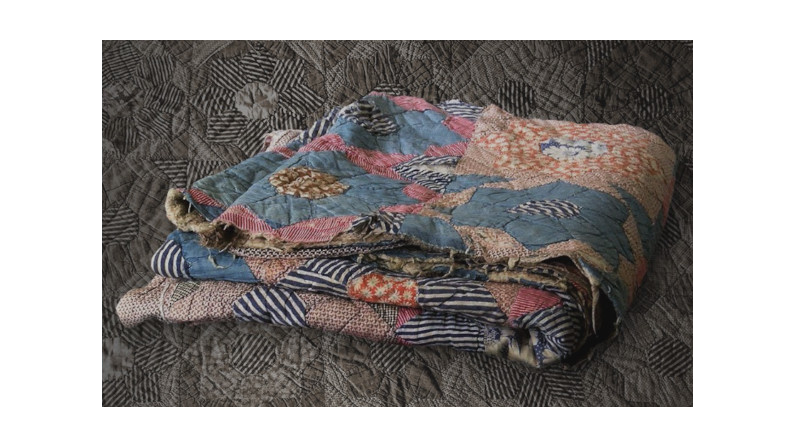
Shizuko’s Quaker quilt
Shizuko's Quaker quilt, given during wartime incarceration, became a lasting fixture of one family's life and a gentle record of kindness shown under hardship.
A gift thrown over the fence

internment, 1942
Shizuko Ina was one of more than 120,000 people forcibly displaced and detained during the Second World War (1939 - 1945). Following the attack on Pearl Harbor, the US government imprisoned Japanese Americans, including citizens and non-citizens alike, in 10 so-called 'War Relocation Centers'.
Life in the camps was harsh, especially for expectant mothers like Shizuko, who was interned while pregnant. Like many families, she was first sent to a temporary assembly centre before transfer to one of the permanent camps. The quilt entered her life at Tanforan Assembly Center, near San Francisco.
One day, a woman from the American Friends Service Committee (AFSC) approached the camp's fence. Spotting Shizuko, and perhaps noticing her pregnancy, the Quaker woman heaved the quilt over the barbed wire and called out gently, “I hope this helps.” The quilt remained with her through the seasons that followed.
A thread through separation and survival
The quilt stayed with Shizuko through several relocations to other prison camps. During one such period, her husband, Itaru, one of several camp leaders who had spoken out against their imprisonment, was separated from her and detained by the Justice Department. Worn but well loved, the quilt offered comfort and continuity throughout.
After the war, Shizuko settled in San Francisco. The quilt remained part of her bedding, layered beneath the chenille bedspread. Her children, including her daughter Satsuki, grew up seeing it without knowing its story. It was simply 'Mother's blanket'.
Only when the children suggested throwing the old quilt away did Shizuko explain its origins and what it meant to her.
From then onwards, her family came to see it not merely as a memento, but as a piece of Quaker witness kept through the decades.
Peace in every stitch
Quilting has long been used by women across cultures to carry stories and record hardship. This handmade quilt bore no slogans, yet its stitching connected a stranger's gesture to a family's survival. The name of the woman who gave it has not survived, but the gesture itself is recorded in Satsuki Ina's own writing about her mother's experience.
For Shizuko, the quilt became part of the physical fabric of her home after the war, and later a starting point for her own public accounts of internment. She spoke about both the injustices of the camps and the acts of kindness that made survival possible, citing the quilt as one example.
A shared legacy
Shizuko later became active in remembrance and reconciliation work, collaborating with peace groups connected to Friends. Her account is one record among many of how Quaker testimony takes shape not only in Meeting for Worship, but in direct action.
The AFSC continued its work long after the war, supporting Japanese Americans as they rebuilt their lives and advocated for redress. Shizuko's quilt is now preserved by her descendants and has been shown in community exhibitions on wartime internment and in Friends' Meetings.
As Shizuko herself later reflected:
“I held on to this blanket in camp because it helped me to remember that someone on the outside cared.”
The woman who passed Shizuko's Quaker quilt over the fence was never identified — yet her single act of care has outlasted the war and the camps that once divided them.