
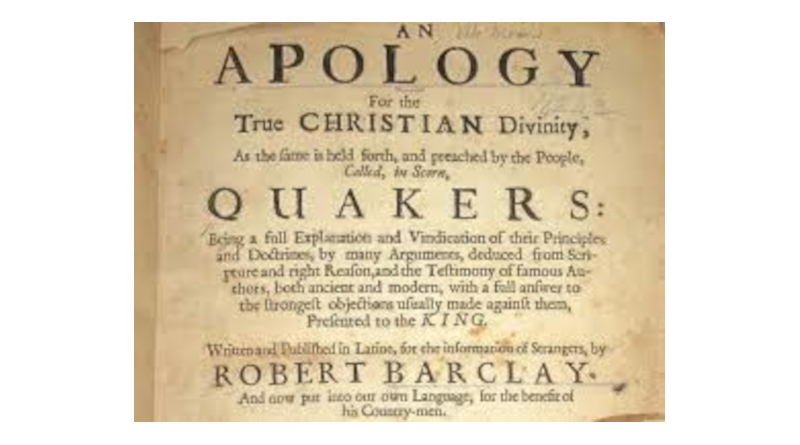
Robert Barclay's Apology
Robert Barclay's Apology (1678) gave early Quakerism a clear, systematic defence of inward revelation, free grace, and the universal reach of Christ's Light.
A Quaker theologian in a hostile age
Robert Barclay was born in Scotland in 1648 into a well-connected family and educated partly in France, where he encountered Roman Catholic theology as well as wider European debates about Christianity. He became a Quaker in the 1660s, at a time when Friends were widely suspected, mocked, and persecuted across Britain.
Early Quaker preaching had been prophetic, experiential, and confrontational. George Fox
His response was An Apology for the True Christian Divinity (full title), first published in Latin in 1676 and in English in 1678. Written for the information of strangers and addressed to critics and authorities alike, the book sought to defend Friends before church leaders, universities, and political power. It became the most influential theological statement of early Quakerism and remains widely read among Friends today.
What does 'apology' mean here?
In modern English, the word apology suggests regret or saying sorry. In the 17th century, however, it carried a very different meaning. An apology was a reasoned defence - a formal argument offered in reply to critics.
Barclay's Apology is therefore not an admission of fault, but a sustained explanation of Quaker faith. Drawing on Scripture, classical theology, and careful reasoning, Barclay sought to show that Friends were not abandoning Christianity, but recovering its spiritual core as primitive Christianity. He presented Quaker beliefs as coherent, biblical, and ethically demanding rather than eccentric or socially dangerous.
The work is organised into a sequence of numbered Propositions, each addressing a disputed point of theology: the nature of revelation, the authority of Scripture, the universal work of Christ's Light, worship and ministry, justification and holiness. This structure allowed Barclay to translate the experiential language of early Friends into a disciplined theological system.
Convincement
At the heart of Barclay's theology lies the early Quaker experience known as Convincement. This was the moment when individuals felt inwardly persuaded and transformed by God's action within them, rather than converted merely by outward preaching or ritual.
Barclay assumed that true faith begins not with intellectual assent but with The Spirit's direct work in the human heart. People are drawn to God because He is already at work within them, awakening conscience and calling them into new life. This was not private sentiment but the beginning of obedience, discipleship, and moral change.
For Barclay, Convincement helps explain why Quaker worship emphasised silence, waiting, and responsiveness to The Spirit's. Faith begins when people attend to what God is already doing within them.
Free grace without moral licence
17th century Christianity was deeply divided over the meaning of grace. Some critics accused Quakers of encouraging moral laxity by stressing inward guidance and divine grace rather than external law or church discipline. These accusations were often framed using the term antinomianism - the claim that believers freed by grace were no longer bound to moral obligation.
Barclay responded carefully. He affirmed that salvation is entirely the work of God's grace in Christ, not something earned by human effort. Yet he insisted that the Light of Christ within reproves sin, reshapes character, and leads into holiness. Grace, in Barclay's account, is not permission to ignore God's will but the power to live it.
This insistence allowed Friends to defend their radical spirituality while maintaining strict ethical expectations.
The Priesthood of All Believers
Another central theme in the Apology is the conviction that Christ alone is the true mediator between God and humanity. No special caste of clergy is required to dispense grace or interpret God's will on behalf of others.
Barclay builds on the wider Protestant idea of the Priesthood of All Believers (see Everyone is their own minister), but gives it a distinctive Quaker emphasis. Because Christ teaches inwardly by The Spirit's, every person can be addressed directly by God. Ministry arises from obedience to that inward leading rather than from ordination or academic training.
This belief helps explain why Quaker meetings lacked priests, liturgies, or pulpits, and why women as well as men spoke in worship. Authority was located not in office, but in faithfulness to the The Spirit's present guidance.
Inner Light, Inward Christ, and 'that of God in everyone'
Perhaps the most familiar theme associated with Barclay's Apology is the doctrine of the Inner Light — sometimes also called the Inward Christ or the Light of Christ within. Barclay argued that Jesus Christ is spiritually present to every person, enlightening conscience and offering the possibility of salvation.
This Light is not a vague moral instinct. Barclay insisted that it is Christ Himself, active through The Spirit, reproving wrongdoing, drawing people toward goodness, and enabling genuine knowledge of God. The Quaker phrase 'that of God in everyone' flows from this conviction: every human life is touched by divine presence and therefore worthy of reverence.
In Barclay's hands, this teaching becomes foundational for Quaker worship, ethics, and social practice. If Christ addresses people inwardly, then silence, listening, and obedience take precedence over ceremony. If God is at work in every person, then violence, domination, and contempt are contradictions of faith.
The Spirit and immediate revelation
Closely linked to the Inner Light is Barclay's insistence on immediate revelation by the Holy Spirit. He argued that living knowledge of God rests first upon The Spirit's inward work, and that Scripture, though fully authoritative, is rightly understood only when read in that Light.
This claim provoked strong opposition from critics who feared that Quakers were undermining biblical authority. Barclay replied that the Spirit who inspired Scripture could never contradict it, but rather leads believers into its true meaning. Without inward illumination, even sacred texts could become lifeless rather than transformative.
In this way, Barclay positioned Quakerism between rigid literalism and uncontrolled enthusiasm: revelation is immediate, but disciplined; inward, yet accountable to the Christian story.
Universal reach and divine love
Barclay also defended the claim that Christ's saving work extends to all humanity. Because the Light of Christ enlightens every person, he argued that an evangelical and saving grace is universally offered, even if individuals resist it.
This theology grounds the Quaker emphasis on universal dignity and divine love. Barclay later developed these ideas more fully in writings devoted to Universal Love, arguing that the gospel calls believers to recognise God's presence in neighbour and enemy alike.
In a century scarred by religious conflict and exclusion, this vision provided Friends with a spiritual basis for refusing coercion in matters of faith and for seeking reconciliation rather than domination.
Still shaping how many Friends understand Christian inward guidance
Robert Barclay's Apology gave Quakerism something it had previously lacked: a systematic theological voice capable of engaging universities, clergy, and political authorities on their own terms. It translated the first Friends' prophetic experience into the language of doctrine without losing its spiritual core.
More than three centuries later, the book still shapes how many Friends understand inward guidance, grace, ministry, and universal love. Barclay did not invent Quakerism, but he articulated it in a form that allowed the movement to endure, adapt, and speak beyond its first turbulent generation.
In doing so, he helped secure Quakerism's place not merely as a protest movement, but as a distinctive Christian tradition grounded in experience, conscience, and the transforming work of The Spirit.