
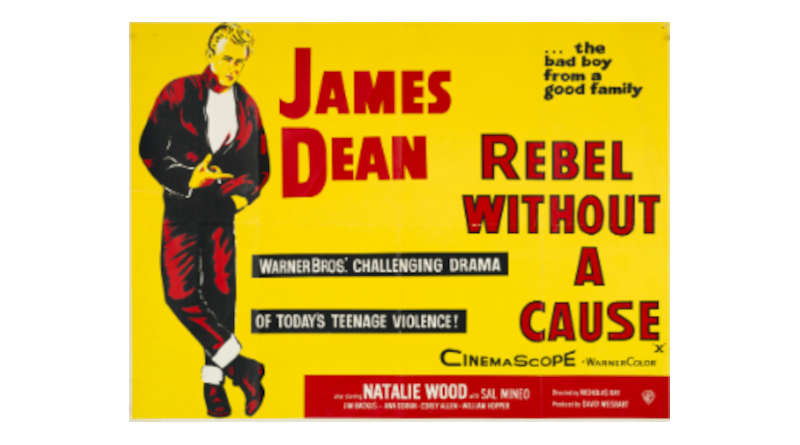
Rebel Without a Cause movie poster
The Rebel Without a Cause movie poster connects James Dean's Quaker upbringing with the much longer history of the Society of Friends challenging accepted conventions for causes they believe in.
Rebel Without a Cause
Released in 1955, Rebel Without a Cause helped turn James Dean into one of the defining figures of post-war American cinema. In the film he plays Jim Stark, a teenager struggling with his parents, his peers and the expectations surrounding him.
The movie poster helped fix that image in popular culture. Dean appears as the outsider, while the title presents rebellion as something almost complete in itself. Yet there was another, less obvious part of Dean's background.
James Dean's Quaker upbringing
Dean was born in Indiana in 1931 and spent part of his childhood in California. After his mother died in 1940, the nine-year-old was sent back to Indiana to live with his aunt and uncle on their farm near Fairmount.
His new home was a Quaker household, and Dean attended the local Friends Church while growing up. When he died in 1955, his funeral was held at Fairmount Friends Church.
There is little evidence that Dean remained a practising Friend as an adult. His Quaker upbringing nevertheless formed part of his early life, while the title of his best-known film provides an unexpected contrast with the history of the Society of Friends.
Quakers as rebels with a cause
From their beginnings in the 17th century, Friends challenged conventions that others took for granted. They refused to swear oaths, remove their hats to social superiors or use titles that placed one person above another. Women preached publicly at a time when female religious authority was widely rejected.
These choices could bring fines, beatings and imprisonment. George Fox was repeatedly jailed, while Margaret Fell was imprisoned after refusing an oath of allegiance and continuing to hold Quaker Meetings in her home.
Such behaviour appeared rebellious because Friends were prepared to stand against custom, religious authority and sometimes the law. Their purpose, however, was not rebellion for its own sake. Friends believed that conscience could require them to act differently from the society around them.
That gives the title Rebel Without a Cause an unintended Quaker contrast. James Dean became famous playing a rebel without a clear cause. Friends have repeatedly rebelled because they believed there was a cause worth standing for.
Dissent in a changing world
As society changed, so did the form of Quaker dissent. John Woolman challenged slaveholding among fellow Friends in the 18th century, while Elizabeth Fry confronted accepted conditions inside 19th-century prisons.
During the 20th century, Friends resisted conscription and defended conscientious objection during wartime. Quakers later joined campaigns against nuclear weapons, including the women's peace camp at Greenham Common.
The causes continue to change in the 21st century. Friends defend freedom of conscience and resist attempts to tell people what they should or should not believe. Quakers promote peace education in schools and challenge governments to take stronger action on climate change and sustainability.
The causes are different from those faced by the first Friends, but the practice is recognisable. Across nearly four centuries, Quakers have continued to question accepted ideas and institutions when conscience leads them elsewhere. History changes the form of the dissent, but not the willingness to stand apart.