
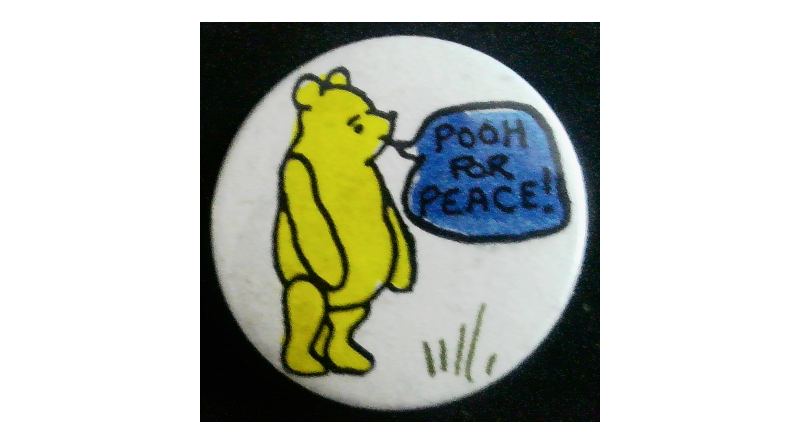
Pooh for Peace
Pooh for peace is a grassroots vintage pin badge that uses a quiet, hand-drawn bear to push back against the heavy machinery of war.
The wobbly ink
The badge relies on a bare, unpolished aesthetic. Against a plain white background, Winnie the Pooh stands in profile, coloured in a bright, solid yellow. The artwork deliberately mimics the gentle, wobbly line-drawings of E.H. Shepard rather than the slick, commercialised animation of later decades.
Pooh stands above a few short strokes of green grass, looking slightly thoughtful. A hand-coloured blue speech bubble emerges from his mouth, containing the hand-lettered black text: POOH FOR PEACE!! The uneven ink shows that this is a piece of street-level folk art, pressed into tin for local community distribution rather than designed by a corporate public relations agency.
The veteran's bear
The connection between this specific bear and the peace movement is deeply rooted in physical history. The character was inspired by a real bear named Winnipeg, a mascot purchased by a Canadian lieutenant in 1914. While the soldiers marched toward the mud and violence of the trenches, the bear was left safely behind the iron gates of the London Zoo—a living remnant of innocence that the war was rapidly consuming.
The character's creator, A.A. Milne, was a veteran who survived the barbed wire and heavy artillery of the Somme. Returning from the Western Front, Milne became a resolute pacifist, eventually publishing a 1934 manifesto against war titled Peace with Honour. The Hundred Acre Wood was not just a naive children's story. It was a deliberate, safe sanctuary constructed by a traumatised soldier—a space completely free from the mechanised slaughter of the adult world.
The practice of the wood
Within Milne's stories, peace is not an abstract political concept; it is a tangible, daily practice sustained by a circle of friends. The animals operate as a community built entirely on mutual aid. Piglet lives with constant anxiety yet finds courage through the steady presence of his friend, proving that peace is found when the strong support the vulnerable without judgement.
Eeyore, with his persistent gloom, is never asked to change; he is included just as he is. This steadfast inclusion acts as a profound form of non-violence. Even Tigger's chaotic energy and Rabbit's rigid need for order are managed through a steady, enduring patience. This steadfast endurance gained renewed cultural weight in the 1980s with the publication of The Tao of Pooh, which highlighted the bear's calm, effortless action as a sturdy, practical alternative to aggression.
A quiet shield
During the heightened Cold War tensions of the 1980s, grassroots activists pressed this pastoral bear into service. Supporters of the Campaign for Nuclear Disarmament and independent peace groups pinned this badge to their heavy coats at damp peace camps, using it as a physical shield against the era's paranoia.
By wearing the wobbly ink of a childhood icon, activists contrasted the safety of the English countryside with the cold, concrete bunkers of the nuclear arms race. The badge argued that the uncomplicated, quiet life represented by the bear was a material reality worth protecting from the bomb.
The censored bear
In the twenty-first century, the bear took on a new role as a subversive icon of silent resistance. Following 2013, citizens in China began using images of Winnie the Pooh to mock President Xi Jinping, using the harmless cartoon to bypass heavy digital state surveillance.
The authoritarian government found this mockery so threatening that they systematically banned the bear from the internet, scrubbing servers and blocking merchandise. The Pooh for peace badge records the origins of this unlikely resistance, proving that an unassuming, hand-drawn bear can become a durable threat to a heavily militarised state.
A gentle witness
Ultimately, the bear remains relevant because he represents a quiet alternative to the noise of modern conflict. Pooh for peace proves that the most courageous act is simply to be kind, acting as a lasting reminder that peace is not just a treaty signed by men in suits, but a honey-pot shared between friends.