
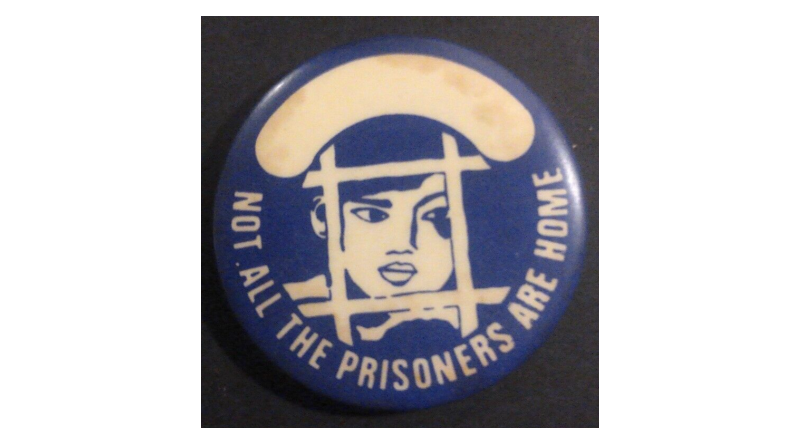
Not all the prisoners are home
Not all the prisoners are home is a vintage Quaker pin badge issued in 1973, to highlight Amnesty International's work in documenting civilian political prisoners in South Vietnam.
The hat and the bars
The badge uses a stark, two-tone design to command attention without relying on complex graphics. Pressed into the celluloid is a deep navy blue background, providing a sharp contrast for the crisp cream-coloured imagery. The text NOT ALL THE PRISONERS ARE HOME curves along the bottom edge in a bold, unadorned sans-serif font, mimicking the urgency of a news bulletin.
At the centre of the badge, a stylised human face looks directly at the viewer. The face is framed tightly behind a grid of four intersecting lines, unmistakably representing the heavy bars of a prison cell.
Resting directly above the grid, perched on the prisoner's head, is a sharp, triangular silhouette. This represents a nón lá, the traditional Vietnamese conical palm-leaf hat. This single piece of clothing acts as a vital geographical anchor. It immediately places the crisis in Southeast Asia without needing to print the word "Vietnam," and it visually confirms that the person trapped behind the wire is an everyday civilian, not a soldier in a military helmet.
The false homecoming
The historical setting for this badge is the signing of the Paris Peace Accords in January 1973. Across Western nations, this treaty was celebrated as the end of direct American military involvement in the Vietnam War. Television networks and newspapers focused their cameras entirely on Operation Homecoming, broadcasting the emotional reunions of returning American prisoners of war stepping off military transport planes.
For the Western public, these images signalled that the war was over and the prisoners were finally free. However, beneath the nationalistic relief lay a massive, ignored reality. While the ceasefire mandated the release of military personnel, it contained deliberate loopholes regarding civilian detainees.
The American Friends Service Committee (AFSC), a prominent Quaker organisation with a long history of international relief work, created this badge to disrupt the clean narrative of a completed peace. By pinning these stark blue buttons to lapels and canvas bags, activists physically countered the triumphant images playing on television screens. They understood that while American troops were flying out, the US-backed South Vietnamese government under President Nguyễn Văn Thiệu was using the treaty's ambiguities to maintain a brutal grip on its own people.
The Third Force
The individuals trapped inside South Vietnam's prison network were not armed combatants captured on the muddy battlefields of the Mekong Delta. The vast majority belonged to a fragile domestic coalition known as the "Third Force." This group consisted of civilian neutralists who refused to align with either the communist North or the military dictatorship in Saigon.
These detainees were the pillars of civil society — Buddhist monks, Catholic priests, university students, and trade unionists. Their only offence was openly advocating for a diplomatic resolution to the civil war. President Thiệu viewed these non-violent peace advocates as a severe threat, and right before the peace accords were signed, his government systematically reclassified these political dissidents as common criminals. This deliberate administrative tactic was designed to bypass treaty obligations and keep them locked away.
The physical reality of their detention was horrific. Many were held in the infamous "tiger cages" on Côn Sơn Island. In these facility blocks, prisoners were packed into cramped, open-air concrete pits beneath heavy iron grates. Guards routinely dusted the prisoners from above with caustic lime powder and denied them adequate water, using malnutrition and medical neglect as standard tools to break their resolve.
The paperwork of witness
While the AFSC used the badge to mobilise public awareness on the streets, they needed hard proof to challenge the government. Amnesty International provided the rigorous, objective groundwork required to validate the Quakers' claims.
In 1973, Amnesty published a definitive report titled Political Prisoners in South Vietnam. Amnesty's researchers and field agents worked under intense surveillance, bypassing state censorship to document the administrative mechanics of Thiệu's domestic crack down. They estimated that between 100,000 and 200,000 civilian prisoners were being held without charge or trial.
This was not abstract political theory; it was a heavy stack of verified paperwork. The report meticulously catalogued the scale of the arrests and exposed the bureaucratic manoeuvre of reclassifying the prisoners. This independent validation transformed the campaign from a simple emotional appeal into an undeniable, documented record of state violence.
Cutting the wire
The combination of the Quakers' highly visible grassroots outreach and Amnesty International's cold, hard data created a sturdy tool for resistance. They used the verified statistics to challenge the official talking points presented by the State Department. The paperwork proved that American tax dollars were actively paying for the concrete pits and the lime powder in South Vietnam.
The relentless pressure from this campaign gradually eroded the political legitimacy of the Saigon regime. By directly linking Western finances to the torture of peaceful neutralists, the activists forced a reluctant US Congress to slash military appropriations and place strict conditions on financial aid packages.
Today, Not all the prisoners are home serves as a physical link of the deep ties between Quakers and Amnesty International — a close working relationship that was forged in these early campaigns and continues in human rights advocacy today.