
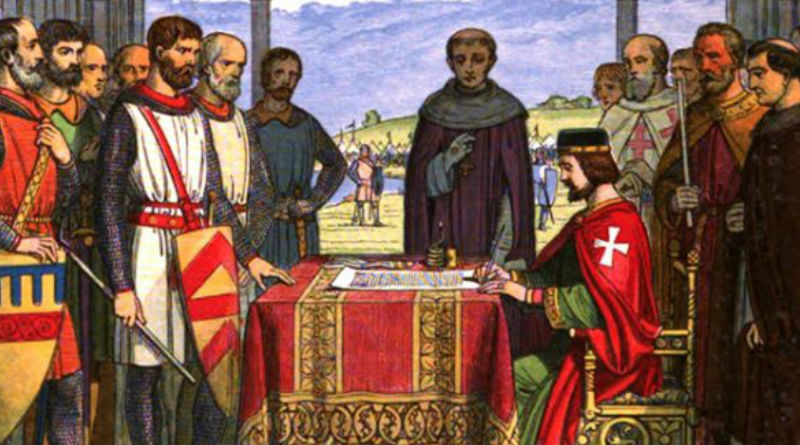
Written in 1215, the Magna Carta (or Great Charter) is effectively the first written constitution in European history.
Magna Carta was sealed by King John on 15 June, in southern England, and contained 63 clauses. The document was drawn up after his barons rebelled and forced him to agree to limitations on his power, because he had demanded heavy taxes to fund his unsuccessful wars in France.
Only a few weeks later, by August 1215, Pope Innocent III had annulled Magna Carta, declaring it null and void for having been sealed under duress. King John died of dysentery aged 50 in October that year.
But, over the course of the next few centuries, the ideals of Magna Carta gathered momentum and assumed a greater authority in respect of the central key clauses concerning liberty and justice.
In the 17th century, Magna Carter inspired two defining acts of English legislation. The first was the Petition of Right (1628):
“No free man shall be…imprisoned or disseised [dispossessed]… except by the lawful judgment of his peers or by the law of the land.”Petition of Right
The second was the Habeas Corpus Act (1679), which referred to Clauses 39 & 40 stating:
“To no one will we sell, to no one will we deny or delay right or justice.”Habeas Corpus Act
In 1776, rebellious American colonists looked to the Magna Carta as a model for their demands of liberty from the English Crown. Its legacy is especially evident in the Bill of Rights and the United States Constitution. Nowhere is this more so than the influence of clause 69 on the fifth and fourteenth amendments of the Constitution, which guarantee:
“Nor shall any persons be deprived of life, liberty or property without due process of law.”United States Constitution
Although much significance was placed on Magna Carta during the 17th and 18th centuries, at the time it was written, the charter was simply a practical solution to a political crisis. The document primarily served the interests of the highest ranks of feudal society by reasserting the power of the barons to limit despotic behaviour by the king.
Magna Carta was written on durable parchment, which was made from dried sheepskin. The scribes who produced it wrote in medieval Latin and abbreviated words to save space on the parchment.
Magna Carta was a quick solution meant to last.
Many copies of the document were sent out to bishops and sheriffs across the country. The exact number is unknown, but four survive: one in Lincoln, one in Salisbury, and two in the British Library.
The 800th anniversary of the original charter occurred on 15 June 2015 and, to this day, Magna Carta is used a symbol for liberty against tyranny.
Magna Carta 2.0 was launched by openDemocracy in 2009, who declared:
“Few legal documents resonate in the collective consciousness like Magna Carta. Imposed on King John at Runnymede in 1215 by a consortium of feudal barons, the Great Charter has come to symbolise the idea that collective action is a proper and successful way to protect our rights and freedoms from arbitrary and unaccountable power and the ambitions of an over-powerful, self-seeking and avaricious state. Nearly eight hundred years on, it is an idea we aim to draw inspiration from in an open and democratic way. It is time for Magna Carta 2.0.”openDemocracy
“We want to make Magna Carta 2.0 a call to people and organisations of all political persuasions across the country to put a stop to the threats to our liberty, clean up the way we are governed and ensure that the state respects the people. We want to do this now and engage with parliamentary candidates ahead of the next general election over the dangers and what they intend to do about them.”
Magna Carta 2.0 highlighted, what it saw, as six dangers to the liberty of society that were:
Unfortunately Magna Carter 2.0 only lasted a few years before it stopped running.
Written in 2021, by YQN, the Magna Carta 3.1 takes it wording directly from the original Great Charter and the following texts: