
Greenham Witch
Greenham Witch is a handmade vintage pin badge that celebrates a protest tactic where activists turned a derogatory insult into their most effective tool.
A silhouette drawn at the wire
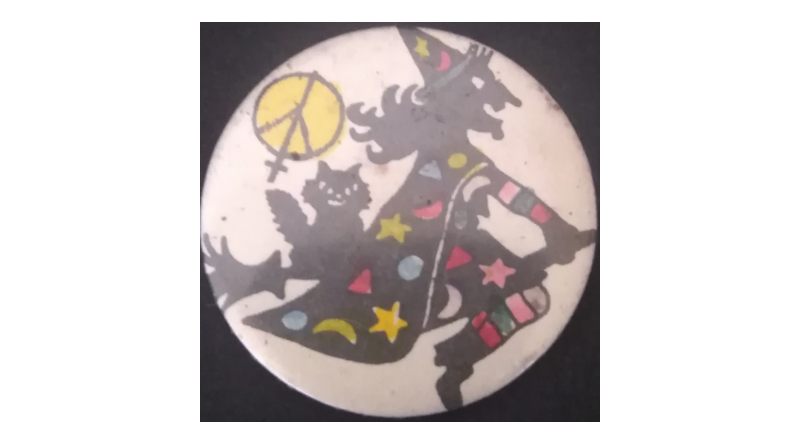
The badge itself is a piece of grassroots art, likely coloured by hand at a peace camp. A simple black silhouette of a witch, complete with a pointed hat, flies across a plain white background on her broomstick. Her cloak is decorated with hand-coloured stars, moons, and simple geometric shapes.
A black cat with a cheerful expression sits behind her, its tail raised. In the sky, a yellow full moon contains the stark lines of the CND peace symbol. Floating just below it is the Venus symbol for woman, making the political identity of the rider clear.
The witch as a newspaper headline
The figure of the witch was a deliberate and powerful choice for the women of the Greenham Common Peace Camp. The British media and authorities, struggling to understand the women's steadfast protest against nuclear cruise missiles, often resorted to derogatory labels. The protesters were dismissed as dirty, unnatural, and eccentric. The insult that stuck was 'witch'.
Instead of rejecting the label, the women of Greenham leaned into it. They reclaimed the archetype of the witch — a woman historically persecuted for her independence and connection to the earth — and turned her into a potent symbol for their struggle, linking their protest at the wire to the historic persecution of independent women.
The bolt cutters under the cloak
This symbol was not just theatrical; it became an instrument for direct action. The practice began at Halloween in 1982, but it was on Halloween 1983 that the tactic reached its most dramatic peak. Announcing a 'Halloween Party' at the gates of the RAF base, hundreds of women arrived in elaborate witch costumes, drawing the attention of the press and the military police.
Expecting only chanting and protest songs, the Ministry of Defence police let their guard down. Hidden beneath the women's voluminous black cloaks, however, were industrial bolt cutters, quietly purchased from hardware shops across the region.
In a coordinated action, the 'witches' drew their tools and systematically dismantled four miles of the base's nine-mile heavy chain-link perimeter fence. The ruse was a stunning success, turning a patriarchal insult into a smokescreen for one of the largest acts of anti-nuclear sabotage in British history.
A legacy in sound and yarn
The Halloween actions were not a one-off event. This creative resistance became a recurring practice. After the 1983 breach, the military responded by turning the base into a fortress, reinforcing the perimeter with heavy-duty fencing and razor wire.
Large-scale fence cutting became impossible, so the Halloween actions evolved. The women adapted their tactics, shifting from breaking the fence to a campaign of sound and symbol. They engaged in "keening" — a form of loud, traditional wailing intended to penetrate the base aurally and unnerve the soldiers within. They continued to weave intricate webs of yarn across the gates, a quiet symbol of interconnected life set against the wire and concrete.
Greenham Witch therefore, is not a record of a single night during the year. Rather it is a symbol that represents a resistance that was both theatrical and tactile. The Greenham 'witches' understood that the state's dismissal of them as eccentric and harmless could be their most effective instrument for change.