
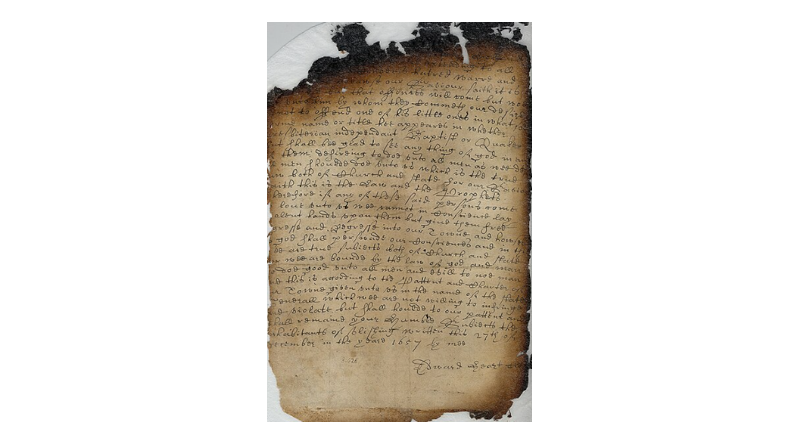
Flushing Remonstrance: Forerunner to the First Amendment
Flushing Remonstrance (1657) is a petition written by settlers in colonial New Netherland defending the right of others to worship freely.
A colony under pressure
In the mid-17th century, the Dutch colony of New Netherland was a place of trade, movement, and uneasy diversity. Centred on what is now New York, it brought together settlers from across Europe, each with their own languages, customs, and beliefs. This mix created opportunity, but also tension, particularly in matters of religion.
At the centre of authority stood Peter Stuyvesant, a committed member of the Dutch Reformed Church, who saw religious unity as necessary for order. As new groups appeared, he tightened control, issuing ordinances that restricted gatherings outside the established church.
Among those arriving were Quakers, whose informal meetings and refusal to conform unsettled the authorities. Their presence exposed a fault line within the colony, between a system that demanded uniformity and a population already diverse in practice.
The persecution of Quakers
The response was direct. Quaker meetings were banned, and those who continued to gather faced fines, imprisonment, or worse. These penalties extended beyond Quakers themselves to anyone who offered them hospitality or space to worship. The issue no longer concerned one group alone, but became a test of how far obedience to authority should reach into private conscience.
This conflict came into sharp focus in the town of Flushing. Unlike other parts of the colony, Flushing had been founded with a degree of promised tolerance, and many settlers took that principle seriously. When ordered to enforce the ban, local officials and residents faced a choice: comply with the governor’s demands or uphold what they saw as a more fundamental obligation.
This moment transformed policy into a moral question. The persecution of Quakers did not simply provoke sympathy; it forced settlers to consider whether denying the rights of others might compromise their own.
The Remonstrance is written
In December 1657, a group of settlers in Flushing put their response into writing. Addressed to Peter Stuyvesant, the document did not protest for themselves but for others. None of the signatories were Quakers. Yet they chose to defend the right of Quakers to live and worship without interference.
The document, later known as the Flushing Remonstrance, set out its case with clarity and restraint. It did not call for rebellion. Instead, it appealed to a higher obligation:
“For we are bound by the law of God and man to do good unto all men…”
In doing so, it shifted the argument from policy to principle.
What made this moment distinctive was its direction. The settlers were not seeking protection for their own beliefs. They were asserting that the rights of others should be respected, even when those beliefs were unfamiliar or unwelcome. A local dispute had become a broader claim about how a society lives with difference.
A declaration of conscience
The power of the Flushing Remonstrance lay in the principle it made explicit. The settlers argued that freedom of belief should not depend on approval or authority. Instead, they grounded their case in a simple idea: coercion in matters of faith was incompatible with both justice and Christian duty.
This meant the document reached beyond the immediate conflict. It extended tolerance not only to Quakers, but to 'Jews', 'Turks', and others, groups that would have been seen as distant or unfamiliar. As the text put it:
“The law of love, peace and liberty… extends to all.”
This was not a plea for leniency. It was a statement that liberty of conscience must apply universally.
In doing so, the Remonstrance reframed the issue entirely. The question was no longer whether Quakers should be permitted to worship, but whether any authority had the right to compel belief at all.
Punishment and persistence
The response from the authorities was swift. Several signatories were arrested, fined, or removed from their positions. Local officials faced pressure to enforce the governor’s orders more strictly. In the short term, the Remonstrance did not secure the freedom it called for.
Yet the act had consequences. Resistance did not disappear, and enforcement proved difficult in a community where many remained unconvinced. Over time, the rigid approach began to soften. By the early 1660s, Quakers were able to meet more openly, and persecution diminished.
What endures is not the immediate outcome, but the pattern it reveals. Faced with unjust authority, ordinary settlers chose not violence, but a public appeal grounded in conscience. In that sense, the Remonstrance stands as an early example of nonviolent resistance.
From colony to constitution (1664-1791)
In 1664, New Netherland passed into English control, but debates over religious freedom continued. Across the colonies, questions first raised in places like Flushing re-emerged as communities struggled to balance authority, belief, and diversity.
Over time, these debates fed into a growing rejection of the coercion of conscience. By the late 18th century, this principle found formal expression in the First Amendment to the United States Constitution, ratified in 1791. The amendment begins:
“Congress shall make no law respecting an establishment of religion, or prohibiting the free exercise thereof…”
It continues by protecting speech, press, assembly, and petition, extending the same principle beyond belief into public expression. This was not created in isolation. It drew on earlier colonial experiences in which people had already challenged the idea that conscience could be controlled by law.
The Flushing Remonstrance stands as a clear early example of that challenge, anticipating the amendment’s core principle: that belief and expression must remain free from government compulsion.
Conscience before law
The significance of the Flushing Remonstrance lies in how closely it aligns with what the First Amendment would later guarantee. Both reject the idea that authority should dictate belief. Both affirm that freedom of conscience is not granted by power, but recognised as something that must be protected.
The connection is not one of direct authorship, but of shared principle. The Remonstrance shows that long before constitutional language existed, individuals were already asserting the same idea in practice: that defending the rights of others is essential to preserving one’s own.
What begins as a local refusal to persecute becomes a wider claim about the limits of authority.
In that sense, the document does more than foreshadow the First Amendment. It reveals the moral foundation on which it rests: that conscience stands before law.
For more see Quakerism across the American colonies and Why and how were the Quakers persecuted?