
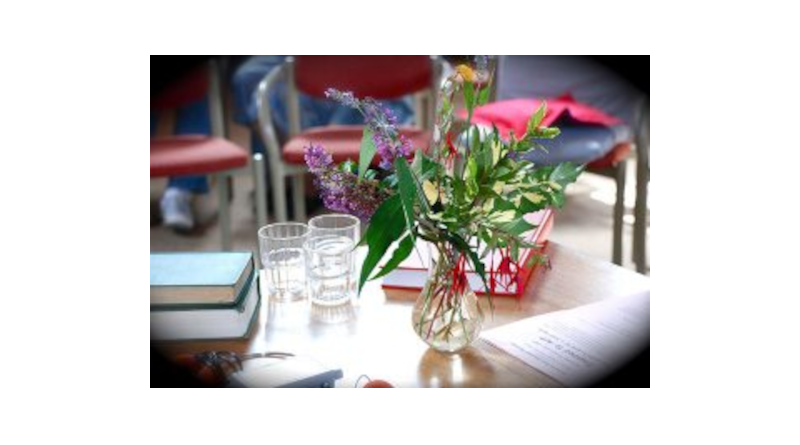
Flowers at a Quaker Meeting
A simple vase of Flowers at a Quaker Meeting reflects Friends' values of beauty, peace, tenderness and silent worship.
Part of the quiet landscape of worship
At first glance, a small vase of flowers at a Quaker meeting may seem an insignificant object. Yet for many Friends and attenders, this gentle arrangement is part of the quiet landscape of worship — a simple, living presence that sits alongside the Bible, the Advices & Queries booklet, and the humble wooden benches of a meeting room. Flowers do not dominate or direct the worship; instead, they act as a gentle companion to the silence, a sign of care and a reminder of the natural world to which Friends feel so deeply connected.
Although Quaker worship centres on silence and inward attention, Friends have always valued the role of beauty in helping create a space that feels grounded, human and welcoming. A modest vase of flowers is one of the few forms of decoration commonly found in meeting rooms, and for many communities it has become a deeply felt tradition.
Why flowers matter in a Quaker meeting
Flowers at a meeting reflect several long-standing strands of Quaker spirituality. The first is simplicity. The arrangement is usually modest — a few stems from someone's garden or a small bunch from the market — never lavish or showy. This humility echoes the original testimony that Friends should avoid excess, extravagance and ornamentation that distract from the divine.
A second is community. The flowers are often provided by different Friends each week as a small act of service. Someone may pick them on the way to meeting, or arrange them before opening the doors. This quiet rota of care helps weave the fabric of belonging — a physical reminder that worship is held together by many small, unseen acts of love.
A third is attentiveness. In the stillness of worship, the flowers sometimes catch the eye during ministry or personal reflection. Their colours, seasonal character and fragility resonate with many Friends' experience of the Light — moments of beauty arising in the midst of ordinary life.
A brief history of flowers in meeting houses
Historically, early Friends avoided decoration of any kind, partly to distinguish themselves from the highly ornate churches of the 17th century. Meeting houses remained plain, functional and unadorned for generations. Yet even in those early years, Friends were also gardeners, farmers and people deeply rooted in the landscape. By the 19th century, small floral arrangements began appearing in some meeting rooms, offered not as decoration but as a quiet encouragement to the spirit.
Minutes from various 20th century meetings show the practice becoming more common, often linked to women's ministry and care for the meeting house. Today it is a widespread — though never compulsory — part of Quaker worship culture across Britain and beyond. The practice remains characteristically Quaker: unfussy, modest and rooted in service.
Real-life examples of flowers shaping worship
Many long-standing meetings have stories associated with their flowers. Some meeting houses rely entirely on what blooms in the garden outside — camellias in spring, roses in summer, dahlias and berries in autumn. One rural meeting in Wales keeps a communal flower bed specifically so that Friends on duty can pick whatever is in season.
During times of difficulty or grief, the flowers sometimes become a focus of tenderness. At Hertford Meeting, Friends quietly placed white flowers on the central table following the death of a much-loved elder. At another meeting in Sheffield, a child arranged sunflowers in the middle of the room as part of All-Age Worship, prompting ministry about hope and resilience. In each case, the flowers served as a shared language of care.
Symbolism of flowers in Quaker spirituality
While Friends avoid set liturgy, flowers often carry meanings that gently harmonise with Quaker spirituality: renewal, growth, seasons, transience and the sense that beauty lives alongside sorrow. The short life of cut flowers can also speak to the truth that all things change — a theme woven throughout Quaker ministry and experience.
Friends from other traditions sometimes remark on how the flowers in a meeting house feel 'alive but still', a phrase that resonates deeply with the Quaker practice of waiting in the Light.
Flowers at Quaker meetings today
Today, flowers remain a cherished but optional part of many meetings. Some Friends prefer the table entirely bare; others value the sense of welcome the flowers give to newcomers. Many meetings rotate responsibility each week so no one person is overburdened.
Increasingly, sustainability plays a role: locally grown, pesticide-free flowers, or seasonal greenery gathered from hedgerows, are increasingly favoured. Some meetings even use small potted plants, which can be replanted and shared.
Whatever form they take, flowers still express something at the heart of the Quaker way — tenderness, simplicity and reverence for creation.