| | by admin | | posted on 16th December 2025 in Badges | | views 47 | |
Christmas badges turn festive imagery into quiet statements of peace, charity, and shared responsibility, using universal symbols that speak across religious and secular traditions.
Christmas badges are among the most understated forms of campaigning material. Usually inexpensive, widely distributed, and worn only for a few weeks each year, they rely on recognition rather than persuasion. Their effectiveness comes from their timing, appearing during a season already associated with goodwill, reflection, and generosity.
Rather than demanding attention, Christmas badges settle naturally into everyday life. Pinned to coats and scarves, they align moral messages with familiar seasonal rituals, allowing peace and solidarity to be expressed quietly and without confrontation.
Early Christmas badges often drew heavily on Christian imagery. Stars, candles, angels, and nativity references reflected societies in which Christmas was still widely understood through a religious lens. Messages of peace were framed in biblical language and spiritual symbolism.
Over time, however, Christmas imagery became increasingly secularised. This shift allowed badges to move beyond church settings and into broader civic culture. Christmas badges gradually evolved into objects that could be worn by people of any faith or none, while still carrying moral weight.
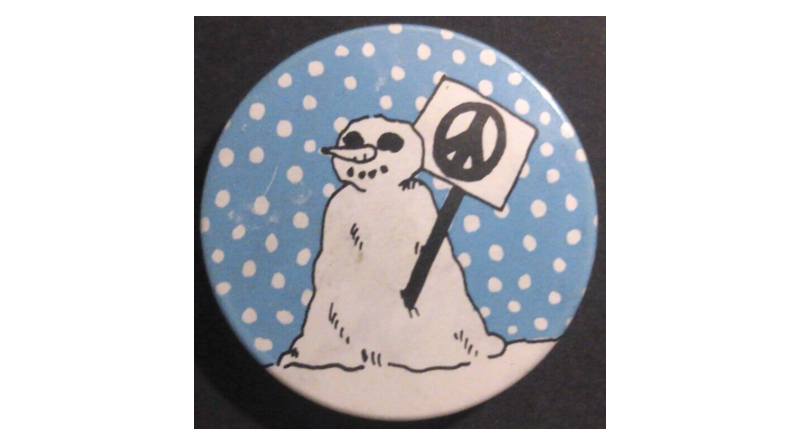
Snowmen, reindeer, and Father Christmas emerged as particularly powerful symbols within Christmas badge design. Unlike explicitly religious imagery, these figures are culturally shared and widely understood. They carry no doctrinal meaning, yet are deeply associated with warmth, kindness, and joy.
Because of their neutrality, these figures became ideal vehicles for peace messages. A smiling snowman or a gentle reindeer could carry a call for peace, charity, or compassion without triggering religious or political resistance. In this way, festive characters became soft ambassadors for universal values.
Father Christmas occupies a unique position in Christmas symbolism. Though secular in modern form, he embodies generosity, care for children, and the idea of giving without expectation. Peace and charity organisations frequently adopted his image to reinforce messages of kindness and responsibility.
Badges featuring Father Christmas often present him not as a commercial figure, but as a guardian of shared values. In this context, he becomes a moral symbol rather than a brand, representing a vision of Christmas rooted in generosity rather than consumption.
The period following the Second World War marked a significant expansion in Christmas peace campaigning. Memories of conflict, combined with anxieties about nuclear weapons, made Christmas an especially potent moment for appeals rooted in peace and reconciliation.
Festive imagery softened these messages. Snow-covered landscapes, friendly characters, and warm colours provided emotional contrast to the realities of war and threat. The result was a form of campaigning that invited reflection rather than fear.
Christmas badges were often aimed at children and young people. Schools, youth groups, and churches used them both to raise funds and to encourage reflection on the meaning of the season. Wearing a badge became part of learning how individual actions could contribute to collective good.
Friendly imagery played an important role here. Snowmen, reindeer, and festive characters made moral ideas approachable, helping children associate Christmas with kindness, peace, and responsibility rather than purely with receiving gifts.
Many Christmas badges extended their message beyond national borders. Appeals for overseas aid, refugee support, and disaster relief were common, particularly during the later twentieth century. Festive imagery helped frame distant suffering as morally immediate.
Because figures like snowmen and Father Christmas are recognised globally, they provided a visual language that transcended borders. In this way, Christmas badges linked local traditions to global responsibility.
Christmas badges were typically produced cheaply and quickly. Tinplate, aluminium, plastic, and printed card were common, often finished with simple pins or safety fastenings. Their designs favoured warmth and clarity over durability.
Intended for brief seasonal use, many were discarded after Christmas. Today, surviving examples function as accidental archives, preserving traces of everyday peace culture that rarely appear in official campaign histories.
By the late twentieth century, Christmas badges became less visible. Digital fundraising, changing fashion, and the growing commercialisation of Christmas all contributed to their decline. Seasonal giving increasingly moved online.
Seen now through collections like Badger4Peace, these badges carry a quiet nostalgia. Their simplicity and sincerity stand in contrast to modern campaign branding, reminding us of slower, more tactile forms of engagement.
For Badger4Peace, Christmas badges demonstrate how peace culture adapts itself to shared traditions. They show that activism can inhabit familiar, even playful imagery without losing seriousness or purpose.
By using universal symbols such as snowmen, reindeer, and Father Christmas, these badges cross the secular and non-secular divide. They remind us that peace, generosity, and solidarity are values that belong to everyone — quietly worn, briefly seen, and long remembered.
☮️ Organisation: N/A
🕰️ Age: 1970s onwardss
💎 Rarity: (1-10/10) Less common - Haven't seen another one.
⚙️ Material: Various
📏 Size: Various
🎨 Variations: Various
💰 Prices vary
© 2025 badger4peace | made in good faith with peace and solidarity 🕊️