Brighton Seagulls crap on Cruise
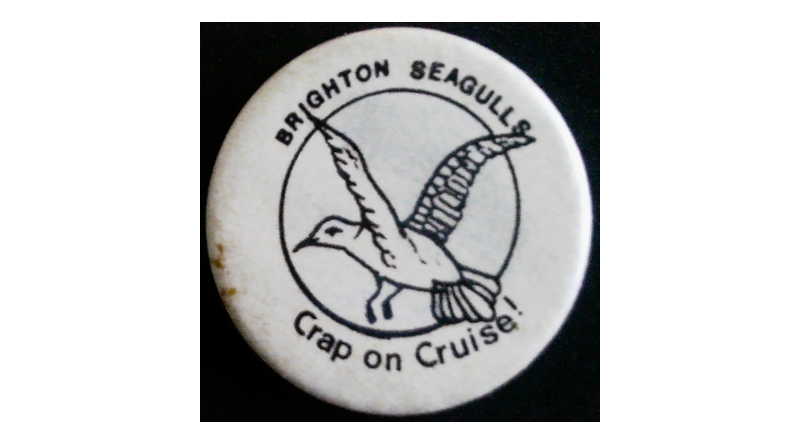
Brighton Seagulls crap on Cruise is a vintage pin badge that combines seaside toilet humour, football rivalry and anti-nuclear protest into one distinctly Brighton joke.
A seagull above a missile
The badge shows a seagull flying above a cruise missile, its wings spread across a circular frame. Beneath them, the slogan Crap on Cruise! delivers the punchline.
Seagulls have a reputation for dropping unwanted surprises from above. In Brighton, however, the bird also carries a particular meaning. It is the emblem of Brighton and Hove Albion Football Club, whose supporters had already turned the seagull's habits into a terrace chant.
Seagulls versus Eagles
Before 1976, Brighton and Hove Albion were known as the Dolphins. That changed on 24 February 1976, when Crystal Palace, whose club emblem is an eagle, visited Brighton's Goldstone Ground. Palace supporters arrived chanting, “Eagles! Eagles!”
In a nearby pub, Brighton supporters decided to answer back. They chose the most familiar bird on the Sussex coast and began chanting, “Seagulls! Seagulls!”
The name stuck. By 1977, Brighton had abandoned the Dolphins and adopted the seagull as their club emblem. The rivalry with Palace, however, grew increasingly bitter during the promotion battles of the late 1970s.
Brighton supporters soon developed a less polite version of their chant. “Seagulls, seagulls, shit on the Eagles” became a familiar sound on the Goldstone terraces.
When the Thatcher government agreed to station American cruise missiles in Britain during the early 1980s, the chant found another target. A seagull that could shit on an Eagle could just as easily crap on Cruise.
Seagulls against the bomb
After 1979, Brighton's Campaign for Nuclear Disarmament grew rapidly. Neighbourhood branches expanded, youth groups formed, and the University of Sussex provided a steady supply of student organisers.
Brighton activists brought anti-nuclear protest into the city's streets. Public die-ins in central shopping areas simulated the casualties of a nuclear attack, while hundreds of residents travelled to national demonstrations, including the 300,000-strong Hyde Park rally in October 1983.
In February 1983, more than a hundred women associated with Brighton CND pitched tents on The Level, a central park with a history of radical gatherings. Their protest responded directly to the mass arrests of women at Greenham Common.
The local movement had developed a character of its own. Brighton's football culture, irreverent humour and street politics provided fertile ground for a badge that could mock nuclear missiles without diminishing the seriousness of the campaign.
A dirty protest from Brighton
No organisation is named on the badge, and its designer remains unknown. Yet the connection between the football chant and the anti-nuclear slogan is unmistakable. A piece of Brighton terrace humour had found its way into the peace movement.
The badge needs neither an elaborate design nor a solemn warning. Brighton Seagulls crap on cruise only needs to point out what a seagull does best, from a great height, to a cruise missile.