
| | by admin | | posted on 21st November 2025 in Quakers in 100 Objects | | views 93 | |
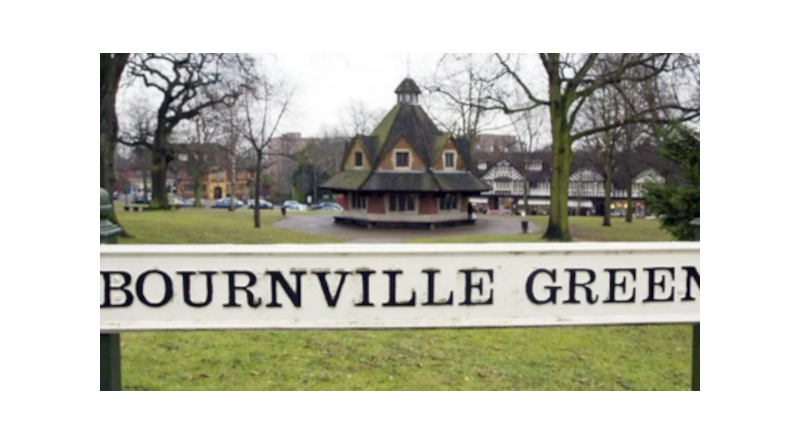
The Bournville Green Sign stands on the village green as a quiet symbol of the Cadbury family's Quaker experiment in planning, wellbeing, and moral purpose.
Bournville began in the 1890s as George and Richard Cadbury's attempt to reshape industrial life through Quaker ideals. They believed a community should nurture the Inner Light in every person - and that healthy, humane surroundings were not luxuries but rights. At the time, many workers in Birmingham lived in soot-darkened courts with little air, water or hope. The Cadburys imagined something radically different: a place where industry, housing and community could exist in harmony.
The first phase of the village was carefully located on rural land south of Birmingham, away from the smoke and noise of the city. The Cadburys had no intention of creating a workers' camp. Instead, they wanted an open, spacious and uplifting settlement where families could flourish.
The Bournville Green sign featured here stands on the village green - the heart of the whole experiment. Like traditional English greens, this shared space was designed as the social and spiritual centre of community life. It hosted fêtes, gatherings, children's play and civic celebrations. From here, the village's most characteristic roads radiate outward, making the street sign a literal and symbolic point of orientation.
Placed on this green, the sign becomes more than a direction marker. It announces an environment shaped by Quaker ethics: tidy hedges, tree-lined lanes, houses set back from the road to allow light and privacy, and a layout crafted to invite neighbourliness rather than enclosure. Even its simple black-on-white lettering echoes Quaker plainness and integrity - clarity without ornamentation.
Bournville's layout was pioneering. Long before modern urban planning took shape, the Cadburys worked with architects and designers who emphasised wide roads to prevent overcrowding, generous front and back gardens for air, food growing and beauty, and green corridors and open spaces to protect mental health.
Roads often followed natural contours, avoiding the harsh gridiron of industrial towns. Low-density housing ensured that every family had room to breathe. The design of Bournville prefigured the Garden City movement by several decades. What we now consider enlightened planning - access to green space, balanced housing and mixed community amenities - was, in the 1900s, quietly revolutionary.
Bournville is famous for its “chocolate box” houses, a nickname that arose long after the village was completed. These cottages, with their half-timbering, pitched roofs, bay windows, porches and flower-filled gardens, conveyed warmth and charm.
But their beauty was not frivolous. The Cadburys believed that attractive surroundings encouraged dignity, pride and moral wellbeing. Each house was designed to feel individual yet harmonious, avoiding the dreary uniformity of later mass housing. The variety in shapes, façades and small architectural flourishes reflected a belief that working families deserved beauty - that pleasant homes were not only for the wealthy.
One of the most distinctive - and often misunderstood - features of Bournville is the absence of public houses. The Cadburys were part of a strong Quaker temperance tradition concerned with the social harm caused by alcohol in Victorian cities. Drunkenness, debt, domestic violence and poverty were widespread in industrial Birmingham, and many reformers saw alcohol as both symptom and cause.
George Cadbury did not impose a harsh moral regime but sought to create conditions in which healthier choices were easier to make. Instead of pubs, the village provided sports facilities, parks and playgrounds, clubs, reading rooms, social halls, and affordably priced events and community activities.
The idea was simple: if people were given access to meaningful alternatives, exploitation and addiction would diminish. The no-pub rule remains in place today, protected through land covenants that express both Quaker belief in personal responsibility and concern for community welfare.
By the early twentieth century, Bournville had become a global model for socially responsible planning. Reformers from across Europe and America visited to study how a business, guided by conscience rather than profit alone, could reshape the lives of thousands of families.
The street sign on the village green is a humble object, yet it points to all of this: the Cadburys' belief that environment shapes character, that business can uplift rather than exploit, and that beauty, space and dignity are essential to human flourishing.
For modern Quakers, Bournville offers both inspiration and challenge. It stands as one of the most ambitious attempts to embed the testimonies - simplicity, equality, community and stewardship - into the physical world. Yet it also prompts reflection on economic justice, land use and our responsibilities to shape spaces where all can thrive.
The Bournville Green Sign, modest as it is, becomes a symbol of everything the Cadburys hoped their village would be: a map pointing towards a society where fairness is planned into the landscape, where business serves humanity, and where the Light in each person is honoured by the world they inhabit.
© 2025 badger4peace | made in good faith with peace and solidarity 🕊️